
A mining parts dealer in Antofagasta quoted an HP300 concave from a number read off the casting. He shipped it 6,000 km and it would not seat. The seat taper on that head had been revised two years earlier. Two months and one container later, the mine bought from the local OEM branch. The casting was dimensionally perfect. A number copied off a worn casting is a hypothesis, not a specification, and every dealer who treats it as one pays.
Why the Number on the Casting Is Not the Orderable Number
Foundries cast a drawing number, pattern number or heat code into the steel. Dealers order against a commercial part number in the spare parts catalogue. These are not the same string, and on wear parts they diverge more often than they match. One pattern reference may correspond to three catalogue numbers, and one catalogue number may have seen five pattern revisions.
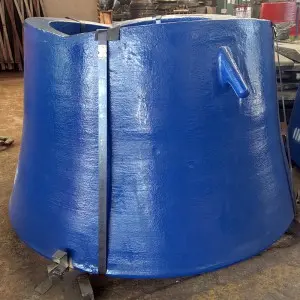
Revision letters are where the money goes. When the seat geometry, head profile or locking arrangement changes, the revision suffix at the end of the number changes, and the new casting will not interchange with the old one even though the base number matches. Capture the full number including the suffix, and make the customer photograph the stamping. A misread suffix is the most common cause of a non-seating mantle. On a Metso chamber, an HP300 concave in 18 percent manganese shows how much detail a valid order line carries.
Reading an OEM Number Structure
Most OEM numbers break into readable blocks. There is a machine family prefix, a component group code, a sequential identifier and a material or revision suffix. Learn the convention for the brands you handle most and have your factory qualify every line. The number still does not tell you the chamber profile, which is chosen by feed and product size, or the eccentric throw setting fitted today.
Know the three grades you are quoting. Genuine means the OEM brand, its warranty and its price. OEM-equivalent means made to the same drawing, material specification and dimensional tolerance, traceable to a heat number. Will-fit means it goes on the machine. Will-fit is not a specification and must never be quoted as one. An HP400 high manganese steel mantle should arrive with chemistry and hardness results attached, not just a stencilled number.
The Data Set to Collect Before You Quote
Price a job before you hold this data and you are gambling with a container. Refuse to quote until every line below is answered.
- Machine make, model and full serial number, read off the frame plate.
- Part number with revision suffix, from the last invoice where possible.
- Chamber designation and eccentric throw as configured today, not as delivered.
- Liner profile code and the feed and product sizes.
- A dimensioned sketch with the four check dimensions marked.
- Photographs of the stamping, the seat and the installed liner.
- Hours on the current set and the reason for the changeout.
Four Dimensions That Catch a Mismatch Before It Ships
Measurement beats paperwork, and four checks catch nearly every error. First, the mating taper angle, measured with a gauge. Second, the overall height from seat face to top, where revision changes show up first. Third, the seat contact diameter at top and bottom, because contact on less than the full taper length cracks a mantle within weeks. Fourth, the thread or locknut specification, including pitch and form, since metric and imperial threads of the same diameter will start and then strip. Have the factory confirm all four before packing and print the measured values on the acknowledgement.
Quote Mantle and Bowl Liner as a Matched Pair
A mantle and a bowl liner are one consumable set, not two line items. Fitting a new liner against a half worn mantle gives poor feed entry and a short campaign. Fitting a new mantle inside a worn liner is worse, because the closed side setting drifts as the liner polishes, and the customer blames the casting.
Quote and ship them together, and state the design closed side setting for the pair. Where the customer insists on one part only, record the remaining thickness on the retained part and note that the life estimate depends on it. A concave bowl liner supplied as 6039052 is only half a specification without its matching mantle profile.
Undercarriage Numbers Follow a Different Logic
Track components are not identified by one number, and dealers who assume otherwise receive a chain that is two links short. A chain is defined by pitch, link count, shoe width, bolt size and bolt spacing, and the shoe again by width, grouser type and hole pattern. Pitch is the trap, because chains of identical nominal pitch do not always run on the same sprocket: bushing diameter and rail profile differ by brand.
Count the links on the machine, since chains get shortened in the field and the plate records the original build. Record shoe width in millimetres, never by description, and confirm bolt diameter, thread pitch and grade. A track shoe for engineering machinery should be bought on all five parameters, never on machine model alone.
Put the Risk Where It Belongs
The order acknowledgement is the cheapest insurance a dealer can buy. Restate model, serial, part number with revision, chamber, profile and the four dimensions and require the customer to sign it back before manufacture. If the customer will not confirm the dimensions, the risk of being wrong should sit with the customer, not with you and not with the foundry. Photograph every casting before loading and file the images with the job.
Dealers who work this way stop shipping hope in containers. The number is a starting point, the measurement is the evidence, and the signed acknowledgement is what keeps a 6,000 km mistake off your books.
Related Pages
- Cast Idler vs Forged Idler: Evaluating on Total Cost of Ownership
- Stable Supply of Excavator Track Shoes: Selecting a Reliable Partner
- Aggregate Equipment Wholesale Purchasing Guide
Post time: Sep-10-2026