
For aggregate equipment distributors managing multiple quarry and sand & gravel sites, procurement decisions extend far beyond comparing unit prices on a single jaw plate or vibrating screen. The core challenge lies in balancing inventory turnover, diverse on-site operating conditions, OEM compatibility, and replacement cycles across a regional network. This guide provides a framework for wholesalers sourcing crushing equipment and wear-resistant parts, covering material science—from manganese steel and high chrome iron to TiC ceramic composites—and machinery including jaw crushers, cone crushers, impact crushers, deep cavity reversible hammer crushers, vertical shaft impactors (VSI), alloy crushers, sand washing machines, feeders, and vibrating screens.
1. Distributor Procurement vs. Single Project Buying
Wholesalers operate across varied geology—limestone, granite, river pebbles, and recycled concrete. Consequently, purchasing lists exhibit three distinct characteristics:
-
Broad Equipment Coverage: Inventory must support common OEM models like Metso HP series cones, Symons 4.25ft configurations, Sandvik jaw crushers, and Hazemag impact crushers.
-
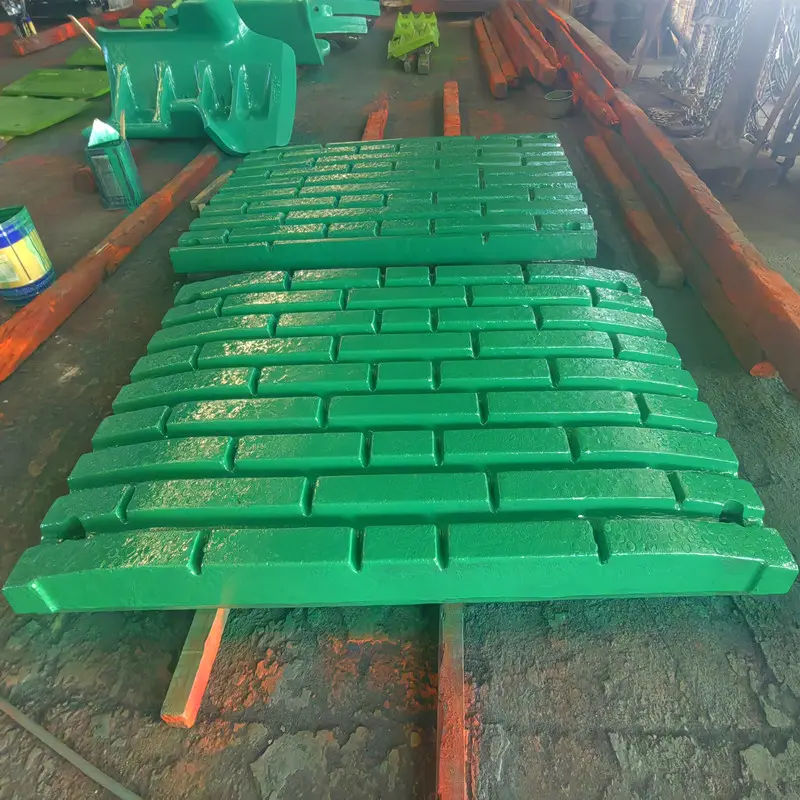
Material Diversity: A single component, such as a jaw plate, requires stocking in Mn13Cr2, Mn18Cr2, Mn22Cr3, and TiC insert variants to match varying abrasion and impact ratios.
-
Standardized Compliance: Full container load (FCL) shipping, ISPM-15 compliant crates, material certifications, batch traceability, and ISO 9001 documentation are baseline requirements, not value-added services.
Distributors calculate value based on the product of “cost per ton” and “shelf turnover days,” not just the initial invoice price.
2. Material Matrix: Selecting the Right Alloy for Abrasion Resistance
Choosing the correct metallurgy is critical for maximizing crusher wear part lifespan.
1. Standard Manganese Steel (Mn13Cr2 / Mn18Cr2 / Mn22Cr3)
These alloys work-harden; surface hardness increases from approximately 200 HB to 450–580 HB under impact while retaining a ductile core.
-
Mn13Cr2: Ideal for low-abrasion soft rock (limestone, dolomite) in secondary crushing.
-
Mn18Cr2: The industry benchmark for secondary/tertiary crushing of hard rock like granite and basalt.
-
Mn22Cr3: Designed for primary crushing, large feed sizes, and high-impact zones with tramp metal risk.
2. High Chrome Iron (Cr20 / Cr26 / ASTM A532)
Offering hardness levels of HRC 56–65, these materials excel in sliding abrasion but lack impact toughness. They are unsuitable for recycling applications with rebar or primary heavy-impact stages.
-
Application:Impact crusher blow bars, VSI crusher wear parts, ball mill liners.
3. Alloy Steel & Carbon Steel Castings
Alloy steels (e.g., ZG42CrMo, 30CrNiMo) are utilized where structural integrity is paramount—such as frame guards, hammer crusher sleeves, and screen machine structural components. Carbon steel is reserved for non-wear structural items like flanges and fittings.
4. TiC Inserts & Ceramic Chrome Composites
Embedding TiC rods (approx. 3200 HV) or alumina ceramic blocks into a manganese or martensitic matrix provides superior edge retention and crack resistance.
-
Prerequisite:Effective magnetic separators and metal detectors are mandatory to prevent catastrophic failure. Ceramic composites are optimal for VSI rotors and fine-crushing impact liners.
3. Equipment-Specific Stocking Recommendations
Strategic inventory management aligns with specific machine dynamics.
Jaw Crushers
-
Critical Wear Parts:Fixed/Movable Jaw Plates, Side Liners, Toggle Plates.
-
Stocking Advice:Maintain Mn13Cr2 for soft rock territories; prioritize Mn18Cr2 for hard rock regions; utilize Mn22Cr2 where tramp metal is prevalent. Always quote using Brand + Model + Serial Number + OEM Part Number (e.g., Nordberg C160, SANDVIK CJ615).
Cone Crushers
-
Critical Wear Parts:Mantles, Concaves/Bowl Liners, Feed Cones.
-
Stocking Advice:Focus on HP400, GP series, CH660, and Symons 4.25ft cavities. Default to Mn18Cr2 for secondary hard rock; stock Mn22Cr3 for primary mining segments; offer Mn+TiC for extreme abrasion with verified tramp metal control.
Impact Crushers (HSI) & Vertical Shaft Impactors (VSI)
-
HSI Blow Bars:Use Cr26 for clean river pebbles/quartz; switch to Mn18 or Martensitic steel for demolition/recycling feeds containing rebar to prevent shattering.
-
VSI Components:High Chrome + Ceramic inserts significantly outperform standard alloys in high abrasive index environments.
Deep Cavity Reversible Hammer Crushers & Alloy Crushers
-
Hammer Heads:These endure combined impact and wear. Recommend bimetallic composites (high chrome working end + alloy steel handle) or zone-hardened heads to prevent premature breakage.
-
Alloy Crushers:Often deployed for extra-hard ores and sintered materials. Maintain separate BOMs for these specialized wear parts.
Sand Washing Machines, Feeders, and Vibrating Screens
These auxiliary machines drive high-frequency repeat sales:
-
Sand Washer: Spiral blades and tank liners require medium chrome alloys or wear-resistant steel plates.
-
Feeders: Apron feeder pans and liners should match feed size, utilizing Mn13 or Hardox-like welded structures.
-
Vibrating Screens: Screen panels should be selected based on moisture—Polyurethane (anti-clogging), Manganese Steel (impact), or High Chrome (fine, abrasive materials).
4. Essential Data for RFQs: Reducing Quote Variance by 30%
Distributors should standardize their inquiry templates to include:
-
Crusher Brand / Model / Serial Number
-
OEM Part Number (if applicable)
-
PDF/DXF/DWG Drawings or physical samples
-
Material Type (Granite, Limestone, River Pebble, Recycled Concrete)
-
Feed Size (F80), Moisture Content, TPH (Tons Per Hour)
-
Desired Material Grade (Specify Mn18Cr2 or Cr26, avoid “Supplier Recommended”)
-
Heat Treatment Requirements (Specify Water Quenching for Austenitic Manganese Steel per ASTM A128 standards)
5. Supplier Qualification Checklist
-
In-house Foundry: Ensure production control rather than trading intermediaries.
-
Testing Capability: Spectrometers, hardness testers, impact testing machines, and UT reports must be available.
-
Documentation: Provision of Chemical Composition and Mechanical Property reports per batch.
-
Customization: Ability to manufacture based on drawings for Symons, Metso, Sandvik, Terex, and Telsmith profiles.
-
Logistics: Proven FCL shipping capabilities with steel pallets/crates and responsive technical support (<24 hours).
6. Inventory Stratification Strategy
Optimize warehouse space through tiered stocking:
-
Category A (Fast-Moving): Mn18Cr2 Jaw Plates, HP400 Mantles/Concaves, Cr26 Blow Bars. Maintain 2–3 batches of safety stock based on regional monthly consumption.
-
Category B (Condition-Specific): Mn22Cr3 Primary Liners, TiC Insert Cone Kits. Stock semi-finished blanks or produce against firm orders.
-
Category C (Long-Tail): Zone-hardened hammer heads, Alloy Crusher specific parts. Retain only tooling and drawings; avoid holding finished goods.
By implementing material stratification and cross-compatibility matrices, distributors can maximize market coverage while minimizing obsolescence and returns.

Post time: Jul-31-2026