
Selling cone crusher wear parts to miners and quarries looks easy until the first bowl liner arrives and does not seat. A cone crusher lives and dies by the gap between the mantle and the concave, so a profile that is even slightly off wastes power, makes poor-shaped product, and burns through liners early. For distributors, the question is not “who is cheapest” but “who can prove the part fits the machine it claims to fit.”
Why the Part Number Matters More Than the Picture
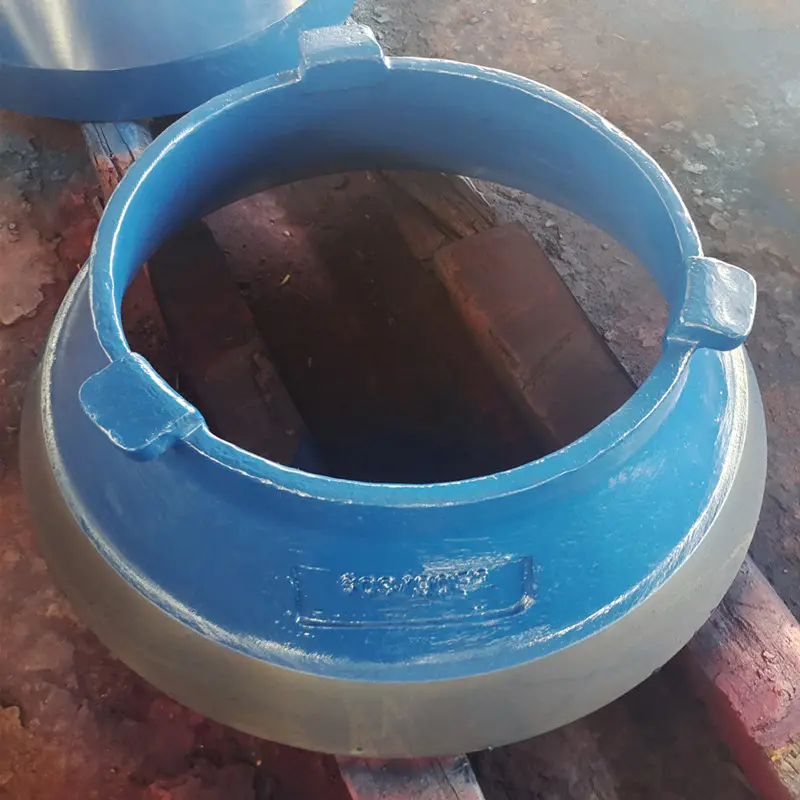
Every cone crusher builder – Symons, Sandvik, Metso, Terex and the rest – uses its own numbering for bowl liners, concaves and mantles. A distributor who can cross-reference a customer’s part number to a confirmed pattern wins the order; one who guesses loses it and the relationship. WUJING MACHINE lists more than 30,000 different replacement wearing parts and adds roughly 1,200 new patterns every year, which means the odds are high that your customer’s number is already in the library. The 4.25 ft cone crusher bowl liner and concave set built to part number 4829.9211 is a good example, and you can see the full fitment table here.
Material Options Should Match the Rock, Not the Catalog
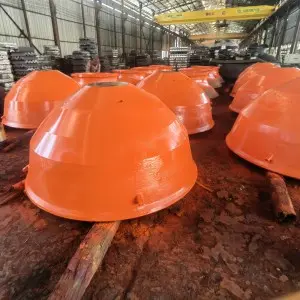
Not every mantle should be the same steel. Abrasive ore needs more manganese and sometimes a molybdenum addition, while recycled concrete is kinder and lets you trade hardness for cost. WUJING offers high-manganese steel in both standard and customized grades, plus high-chromium cast iron, alloy steel and carbon steel, with the material specified at enquiry stage rather than after the pour. The high-manganese mantle built to part number 6666-5514 shows how a single confirmed pattern supports a 4.25 ft machine, and the detail page is here.
MOQ of One Piece Changes the Game for Small Buyers
Most distributors assume wear parts carry a heavy minimum. On these listings the minimum order quantity is a single piece, with supply ability quoted at 10,000 pieces per month and an FOB price range that scales with specification. That lets a small reseller test a new supplier with one bowl liner instead of a full container, which is exactly how trust gets built in this market.
Confirm the Cavity Before You Confirm the Container
Cone liners are sold by cavity – fine, medium, coarse, extra-coarse – and the wrong cavity changes the product size distribution your customer is contracted to deliver. The HP400 bowl liner and concave range is documented with a long part-number table so you can match the exact cavity and machine serial, and you can review it here. Spend the time to confirm the cavity with the end user; a wrong cavity is a returned container, not a discount.
Drawing, Mapping, and First-Article Control
For non-standard or older machines, the safest suppliers offer physical mapping: a technician measures the worn part on site and turns it into a drawing before production. That service is what separates a foundry from a trader, because it removes the guesswork on machines that left the OEM decades ago. Ask whether the supplier keeps the measured drawing on file so the second and third repeat orders are identical to the first.
- Cross-reference the part number against the supplier’s pattern library before quoting your customer.
- State the material and cavity in writing on every purchase order to avoid silent substitutions.
- Request a first-article inspection report on the initial order, then rely on it for reorders.
Lead Time, Logistics, and the Reorder Rhythm
Cone liners are planned downtime items. Your customer knows roughly when the current liner will be worn to two-thirds thickness, so they plan the change-out. That means your reorder lead time has to be shorter than their wear cycle, or you lose the repeat. With a 40,000-ton annual capacity and a broad pattern library, suppliers like WUJING can treat repeat bowl liners as stock-grade production rather than a custom job, which is the realistic path to a dependable reorder rhythm.
Payment Terms That De-Risk the First Order
Beyond fit and material, the commercial terms decide whether a distributor can actually start. A 30/70 or 30/40/30 payment structure - deposit, balance against bill of lading, and a held portion after installation – protects both sides on a first order. Suppliers with 10,000 pieces per month of capacity and a 40,000-ton annual run can usually accept staged terms because production is predictable, which lowers the barrier for a distributor moving from a competitor’s catalog to a direct source.
For distributors, the win is not one perfectly priced liner. It is becoming the supplier a quarry trusts to get the right mantle and bowl liner, in the right material, every time the crusher comes down for service.
What a distributor should put in the first quote
The fastest way to lose a quarry’s trust is to quote a liner you cannot prove fits. Put the confirmed part number, cavity, and material grade in the first line of every quote, and attach the supplier’s pattern-library match so the buyer can verify it himself. A quote that shows the cross-reference upfront reads as expertise, while a quote built only on a photo reads as a gamble the customer will not take with a machine that is down for service.
Related Pages
- News – Top C125 Jaw Plate & Flywheel Casting Factories for US Aggregate Mines
- News – Why China Leads Global Mining Casting Spare Parts Production
- News – How to Verify Manganese Steel Heat Treatment Certifications
- News – Core KPIs to Evaluate Long-Term Mining Parts Partners
- News – Complete Foundry Factory Audit Checklist for Mining Wear Castings
Post time: Sep-08-2026