
You are holding a jaw plate drawing from a customer who wants 40 swing and fixed plates for a QJ340 by next month, and the tolerance block is blank in three places. That blank space is where a costly mistake is born, because the foundry will fill it with its own default and the plate may not seat when it arrives. The work here is pre-order discipline: read the drawing like the part will be measured against it, because it will be.
Which grade, Mn13Cr2 or Mn18Cr2, fits the feed?
The grade is the first line on the drawing and the one dealers skip most often, yet Mn13Cr2 and Mn18Cr2 behave nothing alike in the chamber. Mn13Cr2 jaw plate work-hardens well for mid-hard rock and is the default for most quarry feeds, while Mn18Cr2 jaw liner carries more carbon and resists deformation on abrasive, high-impact ore. The recommendation is to tie the grade to the rock type on the order, not to whatever the last batch used.
A Mn13Cr2 Mn18Cr2 mismatch is invisible on paper but shows up as a plate that cups after 1,000 hours instead of tracking flat. Specify the wrong grade and the dealer eats the return, because the crusher owner will not accept a plate that changed shape in service.
For a swing and fixed set on the QJ340 and C12, the Mn13Cr2 Mn18Cr2 swing and fixed jaw plate for QJ340 C12 is the product to quote against that drawing.
For a high-manganese option on the same machine, the high manganese steel QJ340 C12 jaw liner and jaw plate covers the same specification.

How do you check hole positions against the machine?
Hole positions and wedge seats are where drawings lie by omission, because a 2-3 mm shift in a bolt hole means the plate will not drop onto the QJ340 jaw plate frame without grinding. Overlay the new drawing on a known-good sample and check every hole center, not just the corner ones, because a middle hole drift is the one that jams the wedge. A 0.5-1.0 mm error on the wedge seat is enough to loosen the plate under load and scar the backing.
The weight on the drawing is a free check: a casting that comes in 5-8 kg light against the stated mass is usually thin in the wear face. The suggestion is to weigh the first article on a floor scale and compare it to the drawing before the rest of the 40-plate batch is poured.
What does the flywheel drawing need before you cast?
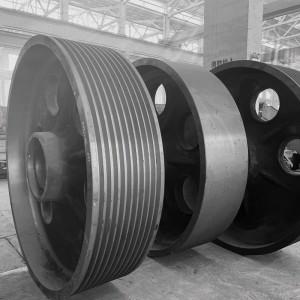
The flywheel is the part dealers forget, yet a jaw crusher flywheel has to be balanced or the whole frame vibrates and cracks the bearing seat. The drawing must show the dynamic balance tolerance and the keyway geometry, because a PH2300 flywheel cut to the wrong keyway will not mount on the shaft it was ordered for. The annotation most dealers miss is the bearing housing bore, which has to match the crusher, not the generic catalogue size.
For the PH2300 model, the PH2300 flywheel casting part for jaw crusher is the product to anchor that line.
For the PE900x1200 frame, the PE900x1200 flywheel casting part for jaw crusher covers the same duty.
A flywheel drawing without a balance grade is a cast-iron guess, and a 200-300 rpm wheel that is out of balance will shake the motor loose within a season. Ship a flywheel with no balance note and the dealer owns the vibration complaint that follows.

Tolerance, weight and the wedge fit
Jaw plate drawing tolerance is the line that decides whether the part is a fit or a floor ornament, so read the plus-and-minus on the wear face first. A face tolerance wider than 2-3 mm lets the plate rock, and a back tolerance over 1.5 mm leaves a gap that fills with fines and welds the plate to the frame. Hold the wear face to 1.0-1.5 mm and the plate seats square on the first try.
The wedge fit is the last thing checked and the first thing to fail, because a loose wedge lets the plate climb under load and the operator hears it before the meter does. Confirm the wedge angle on the drawing matches the machine, and treat any missing angle as a stop, not a default. A missing wedge angle is how a QJ340 jaw plate ends up walking out at 1,000 hours.
Trial assembly on the actual machine frame is the step dealers skip to save a day, and it is the step that catches a 2-3 mm seat error no drawing check will show. Bolt the first article to a spare QJ340 jaw plate frame and swing it before the batch pours, because a plate that binds on the test frame will never behave on the customer’s machine. Keep that first-article plate as the retained sample so the next 40-plate reorder has a physical reference, not just a PDF.
For the QJ340 and QJ240 frames specifically, the casting steel jaw plate for QJ340 and QJ240 crushers is the product to specify.

Ten checks before the purchase order
- Confirm the grade, Mn13Cr2 or Mn18Cr2, is written against the rock type, not left blank.
- Overlay the drawing on a known-good plate and check every bolt hole center to 0.5-1.0 mm.
- Verify the wedge seat angle and the wedge pocket depth before the foundry pours.
- Weigh the first article and compare it to the drawing mass within 5-8 kg.
- Read the wear-face tolerance and hold it to 1.0-1.5 mm for a square seat.
- Check the flywheel balance grade and the bearing housing bore on the PH2300 flywheel.
- Confirm the jaw crusher flywheel keyway matches the shaft the customer actually runs.
- Run a crusher part number check against the machine serial before releasing the batch.
- Keep one first-article plate as a reference sample for the next 40-plate reorder.
- File the drawing with the dealer name so a mining wear parts dealer can trace the spec later.
The discipline pays off as a purchase order no foundry can misread: grade, holes, tolerance, weight and flywheel all stated, so the 40 plates arrive and drop straight onto the frame. A careful mining wear parts dealer turns that drawing into repeat business instead of a returns pile. Read the drawing before you order, and the jaw crusher wear parts fit the first time instead of the third.
Related Pages
- Cast Idler vs Forged Idler: Evaluating on Total Cost of Ownership
- Stable Supply of Excavator Track Shoes: Selecting a Reliable Partner
- Aggregate Equipment Wholesale Purchasing Guide
Post time: Nov-04-2026