In global mining, quarrying, and large-scale infrastructure projects,
jaw plates for jaw crushers and track shoes for construction machinery are typical high-consumption wear parts. For procurement managers, controlling operating costs while ensuring continuous equipment operation is a core KPI. However, the market is filled with uneven suppliers, and tempting low prices often hide huge hidden costs.
From the perspective of global buyers, this article deeply analyzes common tactics of unqualified wear parts suppliers and provides a professional avoidance guide to help you identify genuine high-quality foundry partners.
The Price Trap: Why “Low Prices” Are Often the Most Expensive
Many buyers prioritize price as the primary screening criterion. Yet in the foundry industry, the iron rule of “you get what you pay for” always applies. Unqualified suppliers typically cut costs in the following ways to offer attractively low quotes:
Raw Material Adulteration
Standard jaw plates are usually produced from high manganese steel (Mn13Cr2, Mn18Cr2) or high-chromium cast iron. To reduce costs, inferior suppliers reduce expensive alloying elements such as molybdenum, nickel, and chromium, or even directly remelt recycled scrap steel. This results in excessive impurities in the casting matrix and extremely poor toughness.
Skipped or Substandard Heat Treatment
Heat treatment is the critical process that gives wear parts their performance.
High manganese steel requires strict austempering treatment to achieve an austenitic structure, while high-chromium cast iron needs quenching and tempering.
Unqualified factories often omit or simplify this process, leading to insufficient hardness, or excessive hardness with lost toughness, causing products to crack upon impact.
Low-Precision Molds
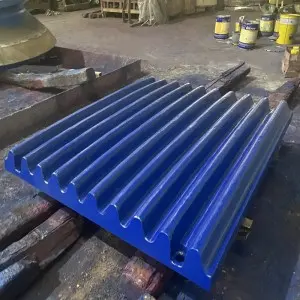
To save mold development costs, rough wooden molds or outdated molds are used. This results in large dimensional tolerances for jaw plates or track shoes, preventing perfect fitting with the main machine. This not only reduces crushing efficiency but also damages the crusher body itself.
Core Warning Signs: Four “Red Flags” of Unqualified Suppliers
Be extra vigilant when potential suppliers show any of the following behaviors:
1. Unable to Provide Material Certificates or Test Reports
A responsible foundry assigns a heat number to each melt of molten steel and can provide chemical composition analysis reports.
If a supplier cannot provide third-party test reports (such as SGS, BV) or in-house laboratory metallographic analysis reports, it indicates a lack of basic process control over product quality.
2. Evasive Discussions on Heat Treatment Processes
When you ask about heat treatment furnace models, temperature control methods, or specific process curves, vague answers or claims like “we rely on experience, not instruments” usually mean the supplier lacks formal heat treatment equipment, or outsources processing to unregulated workshops with completely uncontrollable quality.
3. Lack of Customization Capability and Technical Support
Different ores (granite, basalt, river pebble, etc.) demand different material properties for wear parts.
Professional suppliers recommend suitable materials (high manganese steel, alloy steel, ceramic composite inserts, etc.) based on your working conditions: feed size, discharge size, and Mohs hardness.
Any supplier claiming “we make everything, same service life for all” is clearly unprofessional.
4. Extremely Rough Packaging and Logistics
Wear parts often weigh several tons, with long export transportation cycles.
Unqualified suppliers neglect packaging, applying only basic anti-rust treatment or none at all. Under high-humidity and salt-spray ocean conditions, castings are highly prone to rust and corrosion.
Professional suppliers use fumigated wooden boxes, vacuum packaging, or specialized anti-rust oil, with rational container loading plans to prevent collision damage during transit.
Avoidance Guide: How to Systematically Evaluate Suppliers
To avoid the above risks, buyers are recommended to implement the following Three-Step Verification before placing orders:
Step 1: In-Depth Technical Inquiry
Go beyond price and ask for details:
- “Is your high manganese steel casting fully austempered? How do you ensure complete carbide dissolution?”
- “What alloy composition do you recommend for high-impact working conditions?”
- “Can you provide reference cases from similar mining applications?”
Professional questions quickly eliminate middlemen with only trading capacity but no real manufacturing expertise.
Step 2: Video Factory Audit or On-Site Inspection
If an on-site visit is not possible, insist on a real-time video factory audit. Focus on verifying:
- Spectrometer: on-site chemical composition testing capability.
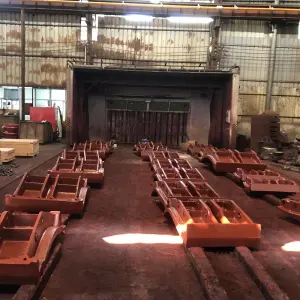
- Heat treatment workshop: adequately sized furnaces for large jaw plates and track shoes, with digital temperature control systems.
- Machining equipment: large CNC machines to ensure precision of mounting surfaces.
Step 3: Small-Batch Trial Order
For newly developed suppliers, do not rush into full-container orders.
First purchase one set of jaw plates or several track shoes for field testing. Record service life and wear patterns (normal wear vs. cracking or chipping). Only after trial data meets standards should the supplier be added to your approved supplier list.
Conclusion
Purchasing jaw plates and track shoes means investing in equipment uptime, not just physical products.
Choosing a supplier with a strict quality control system, transparent production processes, and extensive foundry experience – such as ISO-certified factories with advanced spectrometers and professional heat treatment capacity – may involve slightly higher initial costs. However, the longer service life and lower downtime risk will save you enormous total operating expenses.
Rejecting low-price traps and adhering to value-based procurement is essential for every mature procurement professional.
Post time:
Jul-14-2026