
A New Chain Destroyed in Four Hundred Hours
A contractor replaced the undercarriage on a mid-size excavator after a pre-emptive rebuild, and specified a good quality chain and shoe assembly. Four hundred hours later the bushings were worn past limits and the sprocket teeth were hooked, a result normally associated with two thousand hours or more. The parts were not faulty. The machine had been running with the track adjusted far tighter than the manufacturer’s specification, because a fitter had set it by eye and nobody had rechecked it after the first shift. Everything downstream of that single adjustment, from bushing wear to sprocket profile to rolling resistance, was decided in the first hour of operation.
Tension Is the Cheapest Variable and the Most Expensive Mistake
Track tension is adjusted with a grease fitting and measured with a straight edge, and it controls more of the undercarriage wear budget than any part specification. Too tight, and every component in the chain, the idlers, the rollers and the sprocket carries a continuous load it was not designed to hold. Too loose, and the chain whips, climbs the sprocket, and damages the link ends and the idler flanges. Both failure modes destroy expensive parts, and both are free to prevent.
Measure Sag, Do Not Guess
The standard method is to measure the sag of the track between the top of the carrier roller and the track frame, with the machine parked on level ground and the track clear of debris. Use the figure from the machine manual rather than a rule of thumb, because it differs by machine size and by undercarriage design. A measurement taken on a slope, on soft ground or with mud packed in the chain will be wrong by enough to matter, and a packed chain can read as correctly tensioned when the metal to metal tension is actually very high.
Check tension at a defined interval, and always recheck it within the first few hours of running a new chain. New components seat during the first shift, and the setting that was correct at fitting is frequently tight or loose by the end of it. Skipping that first recheck is the specific habit that produces four hundred hour failures.

Alignment Comes Before Tension
Tension cannot compensate for misalignment. The track must run true through the carrier rollers, the idler and the sprocket, and any angular offset forces the chain to climb and wear on one side of the link and the roller flange. Inspect the idler and the sprocket for centred contact before adjusting tension, and correct alignment first. Tightening a misaligned track simply accelerates the wear on whichever side is already taking the load.
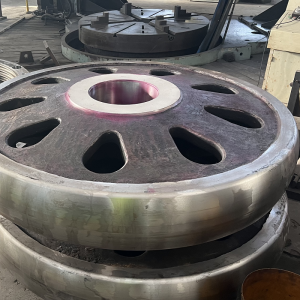
A front idler produced for engineering machinery is the component that shows alignment problems first: uneven wear across the idler face, or a polished band towards one flange, is a direct indication that the track is running off centre. Read the wear pattern on the old idler before fitting the new one, and fix the cause rather than the part.
Sprocket Wear Sets the Rate for Everything Else
The sprocket drives the chain, and its tooth profile determines how the bushing engages. A worn or hooked sprocket will accelerate the wear of a brand new chain, because the bushing no longer seats correctly on every pass. Measure sprocket wear against the service limit every time the chain is changed, and replace the sprocket rather than carrying it over onto new chain. Fitting a new chain to a worn sprocket is the most common false economy in undercarriage maintenance, and it typically halves the life of the new chain.
A excavator driving wheel should be inspected on the same cycle as the chain and never treated as a permanent component. Budget the driving wheel into every undercarriage rebuild as a matter of policy, and the wear rate of the rest of the assembly becomes predictable.
Operating Practice Carries Equal Weight
Even a correctly tensioned and aligned undercarriage is worn out by how the machine is used. Continuous counter-rotation loads one side of the chain and one side of every roller, high speed reverse travel accelerates bushing wear, and working across a slope puts a permanent bias on one track. Rotate the working direction where the site allows it, reduce unnecessary high speed reverse travel, and turn the machine periodically to even out the bias.
These are operating habits rather than parts decisions, and they are invisible in a parts invoice but fully visible in the wear measurements. Include an operator briefing in every undercarriage rebuild, because the cheapest component in the whole system is the ten minute conversation.
Packing and Cleaning Are Part of the Adjustment
Material packed into the undercarriage raises effective tension without changing the adjuster setting. Clay, gravel and frozen material build up around the idler and between the link and the roller, and the chain then runs tight even though the grease cylinder is correctly set. Clean the undercarriage at the end of every shift in sticky or freezing ground, and never measure tension on a packed machine. In cold climates, frozen packing has destroyed more undercarriages than any metallurgical defect.
Build the Inspection Record
Undercarriage decisions should be made on measurements. Record track sag, sprocket wear, idler wear pattern and roller condition at a fixed interval, and keep the record against the machine hours. Once two or three intervals are logged, the wear rate becomes visible and the rebuild can be planned rather than reacted to. A fleet that rebuilds on a surprise is paying emergency parts prices and losing machine availability; one that rebuilds on a trend is not.
A complete undercarriage assembly for engineering machinery should be ordered against that record, with the machine serial number, the hours at fitting and the measured sag setting logged on the job card. That single line turns the next failure into a diagnosable event instead of a dispute.
The Three Settings Worth Getting Right
Undercarriage life is decided by three things that cost nothing to set: correct alignment through the idler and sprocket, sag measured to the manual rather than estimated by eye, and a mandatory recheck within the first shift of a new chain. The contractor in the opening story bought good parts and lost them to a grease fitting, and the difference between four hundred hours and two thousand was one measurement nobody took.
Related Pages
- Cast Idler vs Forged Idler: Evaluating on Total Cost of Ownership
- Stable Supply of Excavator Track Shoes: Selecting a Reliable Partner
- Aggregate Equipment Wholesale Purchasing Guide
Post time: Sep-22-2026