
Six Weeks for a Coupling That Costs Less Than the Downtime
A quarry in Central Asia scheduled a planned overhaul on a jaw crusher during the winter shutdown. The jaw plates were on the shelf, the cheek plates were on the shelf, and the maintenance team was ready. Then the fitters opened the drive guard and found a coupling jaw worn through and a pulley groove polished to a shine. Neither part had been ordered, because neither part is a wear item on anyone’s stocking list, and the crusher stood for six weeks waiting for two components whose combined value was less than a single day of lost production. The plates were never the problem. The problem was that the overhaul list had been written as a wear parts list.
Excavator parts dealers and mining maintenance buyers are generally good at stocking consumables and bad at stocking the parts that only appear during a rebuild. The distinction that matters is not price or size, it is replacement frequency: a wear part is changed on a schedule you can forecast, and a rebuild part is changed on a condition you discover by opening the machine. Because rebuild parts cannot be forecast by consumption, they have to be forecast by inspection, and that means somebody has to look before the shutdown.
Three Categories, Three Different Stocking Rules
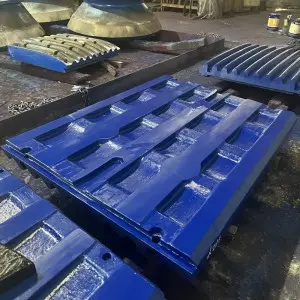
Sort every jaw crusher part into one of three groups before you build a stocking policy. Group one is scheduled wear: fixed and swing jaw plates, cheek plates and wedge hardware, changed on a known cycle. Group two is condition-based machine parts: pulleys, couplings, toggle assemblies and seating, replaced when inspection shows it. Group three is catastrophic spares: pitman and jaw holder castings, replaced rarely and almost never held in stock. Group one can be stocked from consumption history, group two must be stocked from inspection findings, and group three should be identified and quoted in advance but only purchased when a crack is found. Most dealers carry group one well and group two not at all, which is exactly where the six-week delay lives. A standard wear item such as the high manganese steel fixed and swing jaw plate belongs firmly in group one and should never be the reason a shutdown slips.
Open the Drive Side Before You Order Anything
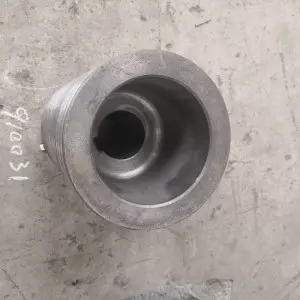
The inspection that prevents the delay takes half a day and needs the guards off. Check four things on the drive side: pulley groove profile, coupling jaw or elastomer condition, belt condition and alignment, and shaft bearing play. A pulley groove worn into a V shape has already destroyed the belt, and fitting a new belt to a worn pulley simply buys another belt failure in a few weeks. Do the inspection two months before the planned shutdown rather than during it, because that is what leaves enough time to order and receive the parts. Model-specific drive components are the classic long-lead items, and a part such as the 910031 pulley suitable for the Metso C125 jaw crusher should be quoted and held against a named machine serial number rather than ordered reactively.
Couplings Fail Quietly and Then Suddenly
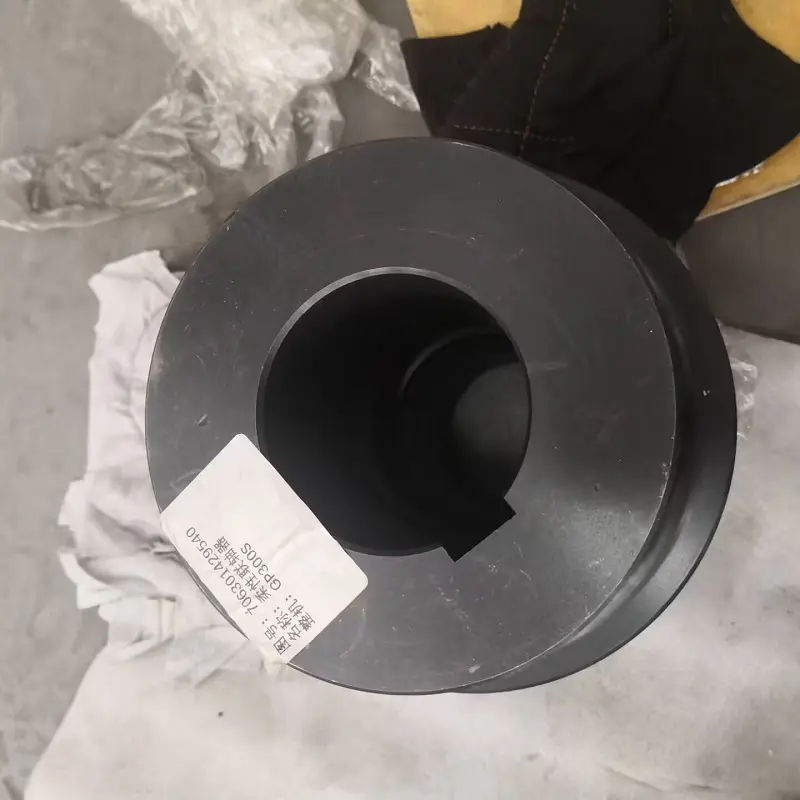
A flexible coupling between motor and crusher absorbs misalignment and shock, and it wears invisibly behind a guard. Look for three signs: rubber or elastomer dust under the guard, a polished or elongated bolt hole, and any measurable radial play between the two halves. Replace the coupling element as a scheduled item every second overhaul regardless of condition, because the failure mode is progressive and the last stage is sudden shaft damage, which turns a cheap part into a very expensive one. Order the coupling and the element together, and confirm the bolt grade supplied with them, because replacement bolts of the wrong grade fail in weeks. A direct-fit item such as the 706301429540 coupling jaw for the Metso C125 jaw crusher is exactly the sort of part that should be on the order sheet the moment the inspection report is written, not the week the shutdown starts.
Structural Castings Are the Ones That End a Season
The pitman and the jaw holder are large carbon steel castings that carry the crushing load. They are not wear parts in any normal sense and they are usually replaced only after crack detection or a serious incident. Crack detection on a pitman is a stop-work event, and the lead time on a large casting is measured in months, not weeks, which is why a cracked casting is the single most damaging finding in a jaw crusher overhaul. Run a crack detection inspection on the pitman, the jaw holder and the frame welds at every planned overhaul, even when nothing looks wrong, because surface cracks in these castings are often invisible under grease and dust. If a crack is found, stop and get the repair procedure from the machine manufacturer rather than welding it locally, because a field weld on a load-carrying casting without the correct preheat and procedure will crack again at the toe of the weld. Where a casting has to be sourced, a component such as the carbon steel jaw holder and pitman for the J-1175/JW42 jaw crusher should be ordered against the machine serial number and the original drawing, never against a photograph.
Match the Plate Material to the Feed, Not to the Habit
The plates themselves are the one part everybody orders, and they are still frequently ordered wrong. Standard manganese plate work-hardens under impact, which is exactly what happens when feeding hard, clean rock. Feeding softer or recycled material with less impact does not work-harden the surface, and a standard manganese plate will wear quickly while a different alloy would have lasted considerably longer. Record the feed material, the feed size and the reduction ratio with every plate enquiry, because a plate that lasted eleven months in granite may last four in a recycled concrete application. A casting steel option such as the casting steel fixed and swing jaw plate is worth evaluating alongside manganese when the feed changes, and the comparison should be run on cost per tonne rather than on purchase price.
Build the Overhaul File for Each Machine
The practical fix is administrative. Keep one file per crusher containing the serial number, the drive component part numbers, the plate material and profile in use, the last overhaul date, the hour or tonne reading at overhaul, and the inspection findings. Dealers who hold this file for a customer can quote an overhaul package in a day and can warn the operator about a long-lead part before it is needed, which is the difference between a supplier and a parts shop. Send the file with the enquiry and the whole overhaul becomes a planned purchase instead of an emergency.
Related Pages
- Cast Idler vs Forged Idler: Evaluating on Total Cost of Ownership
- Stable Supply of Excavator Track Shoes: Selecting a Reliable Partner
- Aggregate Equipment Wholesale Purchasing Guide
Post time: Oct-10-2026