
The Liners Arrived on Time and the Mill Still Did Not Start
A mining maintenance buyer planned a SAG mill reline with the outage window agreed months in advance. The liner set arrived two weeks ahead of schedule, the crew was booked, and the crane was on site. The mill did not start for another nine days, because the sealing washers, the lock nuts and the filler rings that sit behind the liners had been treated as separate, low-value items and ordered when the liner set was already on the water. A reline is only as fast as the slowest item in the kit, and the slowest item is almost never the liner, it is the small hardware nobody ordered.
Every experienced maintenance buyer has a version of this story, which is why the best dealers now sell the hardware as part of the reline package rather than as an afterthought. Dealers who kit the liner set with its own sealing washer, nut and filler ring quantities win repeat reline business, because the alternative supplier leaves the buyer to discover the shortage on day four of an outage. Here is what belongs in the kit and how to specify it.
Think in Kits, Not in Line Items
A liner set is a system. Each liner is held by a bolt, and each bolt needs a sealing arrangement, a nut and, depending on the position, a filler ring that takes up the gap between the liner and the shell. If any one of those is missing or undersized, the bolt cannot be torqued correctly, and a liner that is not torqued correctly works loose. A loose liner does not simply wear faster, it damages the shell, and shell damage turns a planned reline into an unplanned engineering repair. The hardware is cheap; the consequence of missing it is not.
So the first specification question is quantity per liner position, and it should come from the mill’s own bolt layout rather than from a rule of thumb. Ask for the mill’s liner drawing and count bolt positions by row, then order hardware with a deliberate overage, because bolts are lost, threads are damaged and a crew that runs one washer short stops work. Ten percent overage on hardware costs almost nothing against one hour of outage time.
Sealing Washers: The Item That Decides Whether the Bolt Hole Leaks
A sealing washer keeps slurry out of the bolt hole and keeps the joint tight. It is a consumable in the truest sense: it is compressed once, it is never reused, and it must be replaced at every reline. Dealers who sell liners without washers are effectively selling a partial solution. Reusing a compressed sealing washer to finish a reline is the shortcut that produces a leaking mill, and a leaking mill corrodes the shell behind the liner where nobody can inspect it.
Specify washers by part number and by dimension, because a washer that looks right and is two millimetres wrong will not seal. Order the exact reference: an M24 seal and M24 diameter 50 washer set for a Metso Outotec SAG mill should be bought against the mill’s part number, not against a generic M24 description.
Lock Nuts: Torque, Re-Torque and the Standard Behind the Number
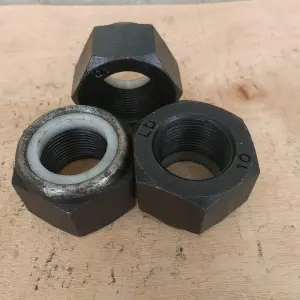
Liner bolts on a large mill are torqued to a specified value and then re-torqued after a defined running period, because the liner beds in and the joint relaxes. The nut has to hold that cycle without backing off, and it has to be replaced rather than reused if its locking feature has been deformed. Nuts are the item most often reused to save money and most often responsible for a liner working loose in the first month of a campaign. Put new nuts in the kit as standard and price them in.
State the standard, not just the thread size. A nut specified only as M48 can arrive in a different property class or a different locking design from the one the torque procedure was written for, and the torque figure then means nothing. A part such as an M48 lock nut to DIN 985 for a Metso Outotec SAG mill carries both the size and the standard, which is the only way to buy it safely.
Filler Rings: The Gap Nobody Measures Until Installation
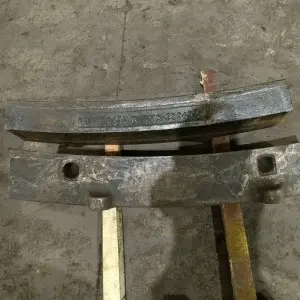
Filler rings take up the space between the liner and the mill shell where the two do not sit flush, and they are position-specific: different rows need different thicknesses. They are also the item most likely to be discovered missing at the point of installation, because the drawing shows a liner and the crew discovers a gap. A filler ring omitted at the reline leaves a liner supported on its bolts rather than on the shell, and that is how liners crack early in the campaign. Order them by row against the drawing, and order spares.
Dealers should ask for the liner drawing at quotation stage and quote the hardware from it, because that is the moment the buyer still has time to accept the extra line. A ring such as a filler ring for a Metso Outotec SAG mill is only correct for its row position, so the order has to list rows rather than quantities.
The Same Rule Applies to Cone Crusher Liner Changeouts
Cone crusher concave and mantle changeouts fail on the same pattern, if less dramatically: the liner arrives, the backing material, the hardware or the torque procedure does not, and the crusher sits for an extra shift. Dealers who supply cone wear should apply the same kit logic, quoting the liner with the consumables the changeout needs. A dealer who can deliver a complete, installable cone liner package beats one who delivers a casting, because the buyer’s cost is downtime rather than steel.
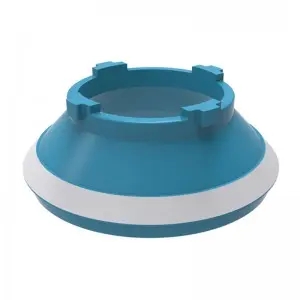
Specify the liner itself against the exact chamber and machine model, and hold it as a matched set with the mantle rather than as a single part. For a machine in this class, a bowl liner concave for an HP400 cone crusher should be quoted with the model, the chamber and the manganese grade stated on the order line.
Where the buyer runs a mixed fleet, standardising on one manganese specification across machines simplifies both stocking and the torque procedure the crew follows. A general stock line of high manganese steel cone crusher concave and bowl liners supports that approach, provided the grade and the machine model are recorded against every item.
Build the Reline Kit Once
One page per machine: liner drawing with bolt rows counted, washer part numbers and quantity with overage, nut standard and quantity, filler ring thickness by row, backing material, torque value and re-torque interval, and the consumables that are never reused. Build that page once per machine and the next reline is ordered from a checklist instead of from memory, which is the difference between an outage that ends on schedule and one that ends in a dispute.
Related Pages
- Cast Idler vs Forged Idler: Evaluating on Total Cost of Ownership
- Stable Supply of Excavator Track Shoes: Selecting a Reliable Partner
- Aggregate Equipment Wholesale Purchasing Guide
Post time: Oct-13-2026