
Your maintenance crew finishes a cone crusher reline on a Saturday night, the plant manager wants nameplate throughput by Monday morning, and the new mantle and bowl liner are still cooling from the backing pour. That Monday-morning pressure is exactly when fresh liners get damaged in the first shift, because the work of a reline does not end when the chamber closes. The liner profile, the backing behind it, and the seating faces all keep settling for the next 100 hours, and the crews that treat those hours as done pay for it in early spalls and short liner life.
Why the First 100 Hours Are Not Like the Rest of Liner Life
A freshly installed mantle and bowl liner do not touch across the full profile on hour one. The backing compound is still curing, the liners are still bedding into the main frame and the head, and small gaps hide under the seating faces where you cannot see them. Running the crusher at full load during this window drives localized contact pressure that cracks the backing and spalls the liner edges before the profile ever matches. The first 100 hours are a controlled bedding period, not normal production.
Limit feed to about 50% of nameplate capacity for the first 8 hours, then raise to 80% by the 24-hour mark and reach full rate only after 100 hours of clean running. A gradual load ramp lets the backing reach full bond strength and lets the two liners wear into a matching profile instead of fighting each other.
Most two-part epoxy backing needs 8 to 12 hours to reach full cure at 20°C ambient, and pit temperatures near 10°C can extend that to 16 hours before the bond is safe. You cannot see cure from the outside, so the clock and the temperature, not the shift schedule, should set your ramp.
The Wujing high quality wear parts 5 ½ cone crusher parts mantle beds in cleanest when the first 8 hours stay below half of the rated feed rate and the chamber stays evenly filled.

The 8-Hour Inspection Checklist
At the 8-hour stop, re-check every hold-down and the mantle lock nut for any movement against the marker paint you applied at install, because a turned nut or a shifted shim means the liner has settled and the clamp load has dropped. This is the single most skipped check, and it is the one that predicts backing failure two weeks later.
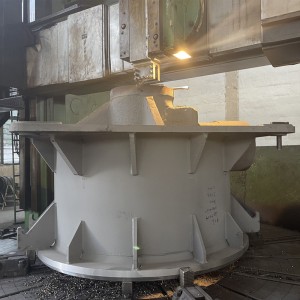
The main frame for cone crusher Metso Sandvik Terex Symons seating must be inspected for backing squeeze-out and for any gap where the liner meets the seat before the crusher returns to production.
Backing that has not cured shows a soft, tacky surface and bleeds resin under the liner edge, and a liner riding on soft backing will walk under load and chew the main shaft threads. Feel the exposed backing at the base of the liner with a gloved hand; if it dents, it is not ready.
If the backing still reads soft at 8 hours, hold the crusher at 40% feed and re-inspect at 12 hours rather than pushing throughput and burying a backing defect under a full chamber.
The 603929 mantle nut Terex Pegson 1000 Auto MaxTrak lock hardware
- Re-index the lock nut to the torque value stamped on the nameplate and confirm the shims sit flush with no tilt.
- Look for backing squeeze-out around the liner base and for any resin weep at the seams.
- Check the main shaft spline for fresh fretting dust that signals relative movement.
- Log the oil temperature and the bearing temperature as your 8-hour baseline numbers.
Why Does the Running-In Period Need a Load Limit?
The question sounds basic, but the answer drives every number in this plan. New liners meet on a narrow band of high spots, and those high spots carry the entire crushing force until they wear flat. A full feed load on a narrow contact band pushes contact pressure past what the backing and the manganese can take, so the edges chip and the profile never develops evenly. The limit is not about the machine; it is about giving the two surfaces time to mate.
A light, steady feed lets the high spots polish down over 8 hours, the backing finishes its cure, and the contact band widens to cover the chamber before you ask for full rate.
The 24-Hour Inspection Checklist
At 24 hours, re-measure the closed-side setting with a lead weight or a steel ball and compare it to the install value, because liner seating typically closes the gap by 1 to 3 mm as the backing settles. Write the number down; it is the reference for every CSS check until the next reline.
A CSS that has drifted more than 4 mm from setpoint signals a loose mantle or a backing failure and must be corrected before the crusher returns to full load. Do not compensate by opening the setting and hoping; find the cause first.
Compare frame vibration to the baseline taken at commissioning, and treat any sustained rise above 4 mm/s RMS in the first 24 hours as a sign of uneven seating or tramp metal lodged in the chamber. Vibration is the earliest warning you get without opening the box.
The cone linings mantle concave McCloskey set should show an even wear band after 24 hours when the CSS and the feed are both centered and the load ramp was respected.
- Record oil temperature and bearing temperature; any steady reading above 65°C is a stop-and-check trigger.
- Confirm the feed is landing centered, not against one liner wall, using a brief no-load visual.
- Raise the feeder to 80% of nameplate only after the CSS and the vibration both check out.
- Mark the actual throughput so you can compare it again at the 100-hour stop.
How Do You Adjust Feed Distribution for the First Time?
Feed distribution is the adjustment most dealers forget, and it is the one that decides whether the liner wears evenly or cuts a groove down one side. Center the feed using the distributor plate or the feed box so the ore column sits within 25 mm of the chamber center, because off-center feed scorches one side of the mantle in the first day and never recovers. A centered column keeps the mantle and bowl loaded symmetrically so the profile develops as designed.
A lopsided wear pattern visible at 24 hours means the chamber is already cutting its own life short and the first feed adjustment was missed at startup. Catching it at 8 hours is cheap; catching it at 100 hours means you already lost liner.
Use a laser or a plumb line to confirm the feed falls through the chamber center, not against the liner wall, before the first full-shift run, and re-check centering after the first 2 hours because the material column shifts as the bin drains.
- Stop the feeder and watch where the material column lands in the chamber.
- Shift the spout or the distributor until the cone of ore is centered on the shaft.
- Set the variable-speed feeder so the chamber stays full but never flooded or starved.
- Re-confirm centering after the first 2 hours of running and once more at the 24-hour stop.

The 100-Hour Inspection Checklist
At 100 hours, pull the wear profile on both the mantle and the bowl liner and confirm the contact band covers at least 75% of the chamber height before you release the crusher to unrestricted production. A full, even band is the proof that the running-in was done right.
A contact band under 50% of the liner height at 100 hours means the chamber was fed too light or off-center and will wear unevenly to the end of the set, so correct the feed before you lose more life.
Compare the actual throughput to the nameplate and confirm it now meets 95% of rated capacity at the same CSS you set at 24 hours, which tells you the liners have bedded and the chamber is working.
The 4830 2892 mining equipment 4.25ft cone crusher wear parts cone liner concave should show a balanced profile across the full chamber after the first 100 hours of supervised running, with no single hot side.
The 100-Hour Post-Reline Inspection Table
Keep this table on the crusher until the liners are released to full rate. Each line is a sign-off, not a suggestion.
- 0 to 8 hours: hold feed at 50%, re-index the lock nut, check backing cure, log oil and bearing temperature each shift.
- 8 hours: re-torque hold-downs, inspect main frame seating, confirm shims flush, look for backing bleed and fretting dust.
- 24 hours: re-measure CSS, compare vibration to baseline, verify feed is centered, raise feed to 80%, check temperatures.
- 100 hours: profile both liners, confirm 75% contact band, verify 95% throughput, then release to full rate.
The crews that sign off all four lines get the full wear life from every set of mantles and bowl liners, because the 100-hour window is where liner life is won or lost. A reline is finished only when the liners have run 100 supervised hours with a steady profile, a stable CSS, and a centered feed, not when the chamber closes on Saturday night. Hand the inspection table to the next shift and the liners will pay you back in tons per millimeter.
Related Pages
- Cast Idler vs Forged Idler: Evaluating on Total Cost of Ownership
- Stable Supply of Excavator Track Shoes: Selecting a Reliable Partner
- Aggregate Equipment Wholesale Purchasing Guide
Post time: Nov-02-2026