
A quarry maintenance buyer who receives a container of crusher wear parts and stacks them on a damp floor learns a hard lesson at the next reline. Correct warehouse humidity control is the cheapest insurance for spares that may sit six months before they are fitted. The cost of a rusted face or a misidentified casting is paid twice: in the lost part and in the downtime when the crusher cannot be lined.
Why do heavy castings fail in storage before they ever crush rock?
Heavy manganese castings arrive with a thin rust prevention coating that protects them only for a short window. A casting stored at 80% relative humidity for three months will show surface bloom a wire brush cannot fully remove before fitment. Corrosion under a liner seat can raise the part and crack the backing compound on the first shift.
The enemy is not the weight but the wait between delivery and the reline. A spare ordered early to beat a long lead time also ages longer than one ordered just in time. Plan the storage conditions before the container is booked, not after it lands on the slab.
How should humidity and rust prevention coating be set up?
Target a warehouse at 60% relative humidity or lower, with airflow that stops damp pooling. Re-apply a rust prevention coating and wrap with VCI paper whenever a part is opened and not fitted within the 6 month inspection window.
Silica packs help only inside sealed bags, not open racking. A 50 mm dunnage gap under each casting keeps the base off the slab and lets air move beneath the weight of the stack. Keep the bay between 18 C and 25 C so condensation never forms on cold steel overnight. The 60% RH target is the one number a storeman can verify with a cheap hygrometer each morning.
N98000821 power distribution plate for HP400 crusher spare parts carries machined seat faces that need a fresh rust prevention coating and VCI paper wrap the moment the crate is opened, because the HP400 power distribution plate often sits in storage longer than the liners it supports.

Stacking layers and dunnage: protecting machined faces
Heavy castings must never rest their machined faces on a bare pallet or on another part’s rough as-cast side. Stacking more than 2 stacking layers on a fragile seat risks a hairline fracture that only shows when the liner is torqued into the crusher during the reline. Use 50 mm dunnage between every layer and mark the top layer.
The machined faces are where the part seats against the crusher body, and a scored face means a loose fit. Keep a soft barrier between machined faces and steel contact, and photograph the stack height at intake.
402-4605-01 toggle plate and deflector plate for Sandvik CJ615 jaw crusher must be stacked flat on 50 mm dunnage with machined faces up, since the toggle plate and deflector plate are easy to damage when heavy castings are piled on their seats.
What must the part number and heat number marking record show?
Every casting should carry its part number and heat number marking, cast in or etched and tagged. A heat number that links to the foundry melt record is the evidence a warranty claim needs when a failure is questioned. The marking is worthless if the tag falls off, so weld a steel tag or stamp the casting directly.
Build a simple storage log with part number, heat number, arrival date, bay and the 12 month shelf review date. FIFO rotation keeps the oldest heat at the front so nothing is forgotten.
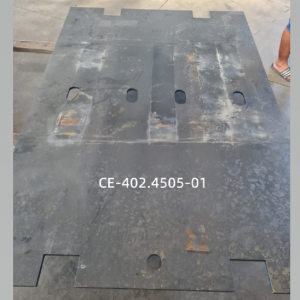
402-4505 wear plate for Sandvik CJ615 jaw crusher side protection should keep its part number and heat number marking visible through storage, so the wear plate can be traced to the foundry melt record if a warranty claim follows an early failure.

FIFO rotation and the 12 month shelf review
FIFO rotation means the first crusher wear parts received are the first issued at the next reline. A 12 month shelf review forces a visual and thickness check on any part that has sat a full year, catching coating loss before it becomes pitting that ruins the seat. Stale stock quietly loses value when storage care cannot be proven later.
Tag each bay with the review month so the storeman pulls the correct heat first. A colour-coded tag system turns the shelf review from a paperwork exercise into a daily habit the team actually keeps.
402-4522-01 lower cheek plate for Sandvik CJ615 jaw crusher frame benefits from FIFO rotation because the lower cheek plate is a low-turnover spare that can pass the 12 month shelf review untouched unless the storeman pulls the oldest heat first.
Opening inspection before the reline and the warranty claim link
Opening inspection at issue is the moment storage discipline pays off or fails. A part pulled without an opening inspection and found cracked on the floor converts a supplier question into the buyer’s own cost with no recourse. Check the coating, the marking, the seat flatness, and compare the heat number to the storage log before the crane lifts it.
The storage record is what protects the warranty claim when a part fails early. A dated log linking part number, heat number and bay to the claim file is the difference between a paid and a rejected claim. Keep the record with the purchase order, not in a system nobody opens.
- Confirm the part number and heat number marking match the storage log before issue.
- Re-apply the rust prevention coating if the 6 month inspection window has passed.
- Check machined faces for bloom and measure seat flatness against the drawing.
- Photograph the casting beside its bay tag as evidence for any later warranty claim.
MM1010146 tighten wedge for Metso C120 jaw crusher assembly needs an opening inspection of its threads and seat before the reline, since the tighten wedge is small, easy to mislay, and only noticed missing when the Metso C120 jaw crusher assembly is half stripped.
Related Pages
- Cast Idler vs Forged Idler: Evaluating on Total Cost of Ownership
- Stable Supply of Excavator Track Shoes: Selecting a Reliable Partner
- Aggregate Equipment Wholesale Purchasing Guide
Post time: Nov-06-2026