
A plant maintenance buyer in Chile books a SAG mill reline and orders the liners, then remembers the grates and bolts only when slurry starts weeping on day three. SAG mill discharge hardware is the set of parts that controls throughput, and ordering it late turns a planned shutdown into a second emergency visit. The grates, the pan lifters, the liner bolts, and the head and shell liners at the feed end belong in one purchase.
The Metso Outotec SAG mill 6.7 x 3.5 is a common frame size whose discharge parts are ordered against the exact shell drawing. A maintenance buyer who lists only the liners leaves the throughput-critical pieces for later.
How do grate port size and open area set throughput?
The grate outer sections carry the ports that let ground slurry leave the mill, and their open area caps the tonnes per hour the circuit can pass. A port that is too small chokes the mill and overloads the pebble crusher with oversize that should have discharged. The outer grate is the first part to size when you plan a reline.
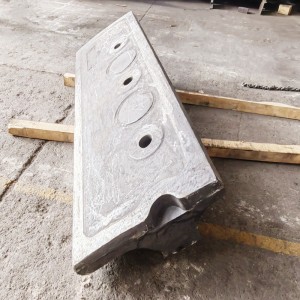
Grate outer 40×40 mm port for Metso Outotec SAG mill 6.7 x 3.5
The 40 x 40 mm port option suits a ball charge and pulp density that the plant’s metallurgist has already signed off. Confirm the port size against the current circuit balance before you cut the order, because the port sets pebble-crusher load. The outer section wears from the discharge side and should be matched to the inner grate it sits beside.
Why is port size chosen against ball charge and pulp density?
A heavier ball charge needs larger ports to keep the same open area without grinding the grate face away. Pulp density sets how fast slurry drains, so a thick pulp demands more open area than a thin one at the same tonnage. The metallurgist, not the warehouse, should set that number.
Guessing the port size from last year’s order ignores the change in feed grade and silently drops mill throughput. Tie the port choice to the latest survey, not to memory.
- Ball charge weight sets the minimum port open area.
- Pulp density sets how fast slurry drains through.
- Feed grade shift changes the port you should order.

What do grate wear patterns tell you?
A grate worn thin at the ports but intact at the rim signals abrasive slurry cutting the discharge face. A grate worn evenly across the face tells you the ball charge is doing its job and the life was simply consumed. The pattern is the only honest report on whether the last port size was right.
Photograph each worn grate on removal so the next order corrects the port size instead of repeating the mistake. Wear that favours one side of the mill points to a load distribution problem upstream.
Why replace outer and inner grates together?
The outer and inner grate sections sit as one discharge screen, and replacing only one leaves a step that chews the new piece. Fitting a fresh outer grate against a worn inner section wears the new part in weeks and wastes the shutdown. The two are a pair in the bill of materials.
Ordering outer and inner grates on the same line keeps the port alignment across the full discharge face. A dealer who splits them is setting up a comeback.
Pan lifters and the pulp discharge behind the grates
Behind the grates the pan lifters scoop pulp toward the discharge and protect the mill end from the ball charge. Inspect the pan lifters during every reline so a cracked lifter does not starve the grate of feed to discharge. They are cheap relative to a lost production day and easy to forget.
The pulp discharge path from pan lifter to grate port is one continuous system that the shutdown should restore as a whole. Leave one piece out and the whole path underperforms.
Liner bolts M48x230 and M48x220 hold the assembly
The shell on the 6.7 x 3.5 mill uses M48 x 230 and M48 x 220 liner bolts in one shell, two lengths that are easy to mix up on the floor. A bolt torqued on a damaged thread weeps slurry and can loosen a whole liner row during the run. Thread condition, not just torque, decides whether the reline holds.
Liner bolt M48x230 and M48x220 for Metso Outotec SAG mill 6.7 x 3.5
Order both lengths together and tag them by location so the crew fits the right one the first time. Specify bolt torque and thread acceptance in the reline procedure so a weeping joint is caught before start-up. The bolts are the cheapest parts in the package and the ones that fail loudest.

Shell liner high feed end for the SAG mill
The shell liner at the high feed end takes the impact of fresh ore and sets the chamber shape where the mill eats. It pairs with the head liner so the feed end wears as a matched set rather than a patchwork. The high feed-end profile is specific to the 6.7 x 3.5 drawing.
Shell liner high feed end for Metso Outotec SAG mill 6.7 x 3.5
Specify this liner against the current wear survey so the profile matches the rest of the shell. The feed-end shell liner and the head liner are ordered as one pairing to keep the chamber continuous. A mismatched profile at the feed end throws the whole grinding trajectory off.
Head liner outer and feed-end pairing
The head liner outer caps the feed end and works directly against the shell liner you just specified. Order the head liner outer with the shell liner so the two arrive as a matched feed-end set for the same shutdown. The outer head liner is the piece most exposed to the incoming ore stream.
Head liner outer for Metso Outotec SAG mill 6.7 x 3.5
Confirm the part number against the shell drawing before cutting the order to avoid a return. The head liner outer and the shell liner share the same feed-end wear budget in the reline plan. Both belong on the same purchase order as the grates and bolts.
What to do next when bundling the shutdown purchase
Open the mill drawing and list the grates, pan lifters, liner bolts, shell liner, and head liner as one bill of materials. Bundle all discharge hardware into a single shutdown purchase so the parts arrive together instead of as six emergency orders. Confirm the port size and bolt lengths against the latest survey.
Send the dealer the shell drawing and the wear survey in one message and ask for one shipment. A maintenance buyer who plans the discharge hardware with the liners protects both throughput and the shutdown window.
Related Pages
- Cast Idler vs Forged Idler: Evaluating on Total Cost of Ownership
- Stable Supply of Excavator Track Shoes: Selecting a Reliable Partner
- Aggregate Equipment Wholesale Purchasing Guide
Post time: Oct-27-2026