
A cone crusher mantle fails in half the expected time when the alloy was chosen by price per tonne instead of by the rock it actually crushes, and a premature failure can stall a 400 t/h plant for a full shift while a replacement is sourced. Mining maintenance buyers who specify a liner only from the catalogue part number usually discover the gap during the hardest ore band of the quarter. The right move is to match the manganese steel grade and any inserted alloy to the abrasion and impact profile of the feed rock, then prove the choice with hardness and metallography checks on the incoming liner.
Which alloy grade suits your feed rock?
Standard 18% manganese steel work-hardens under impact and suits most quarry limestone and the moderate abrasion of a 100 mm feed. High-manganese and low-carbon variants hold up better where the feed carries 20-40% silica and the chamber sees both impact and sliding wear. The feed rock chemistry, not the unit price, should decide the grade, because a liner that lasts 30% longer at 15% higher cost still wins on cost per tonne over a full campaign of 500000 tonnes. Buying the cheapest manganese grade for a high-silica feed can halve liner life and double the changeout labour across a 500000 tonne campaign.
Alloyed and ceramic-inserted grades earn their premium only above a hardness and abrasion threshold. Specify an inserted mantle when the feed routinely exceeds 350 HB in abrasive minerals and the chamber runs hot, because the inserts bridge the gap where plain manganese softens and rolls away under load.
How do abrasion and impact profiles differ by site?
A glacial gravel pit throws high-impact, low-abrasion load at the mantle, so standard manganese thrives and an inserted grade is wasted money. A copper or gold ore with 25-45% quartz is the opposite problem: low impact, relentless abrasion that mills the liner profile away in 60-90 days. The practical split is matching impact-dominant feeds to high-toughness manganese and abrasion-dominant feeds to higher-carbon or inserted grades, then confirming the choice with a wear-pattern photo after the first 1000 hours.
A site that blends ores seasonally should keep two liner grades on the shelf rather than one compromise grade. Running a single soft grade through a hard ore band can cut wear life from 90 days to 35 days with no warning, which is exactly the failure that destroys a maintenance budget and a production target at the same time.
What hardness and metallography checks should a dealer run?
On arrival, the dealer should verify surface hardness in the 200-250 HB range for standard manganese and confirm the as-cast structure with a 100x micrograph before the liner enters the chamber. A proper release check covers three points:
- Surface hardness reading at four points, none varying more than 30 HB from the mean.
- Visual etch confirming the austenitic grain and the absence of carbide networks at the wear face.
- Chemistry certificate showing manganese, carbon and chromium within the agreed 18-22% Mn band.
The metallography step is the one most traders skip, yet it is where a substituted grade shows up. A 100x micrograph is the cheapest proof that the liner in the crate matches the liner on the drawing, and it protects the dealer if the first failure lands inside the warranty window.
Why does the first reline decide the whole liner life?
The first 100 hours after a cone crusher reline decide liner life because uneven torque and an unverified closed-side setting wear one side faster than the other. Operators should re-torque the mantle nut at 8 hours and again at 24 hours, and record the setting against the 16-22 mm target for the chamber. The first reline is where a 10-15% liner-life loss is won or lost, and no second chance appears once the profile is past the running-in phase.
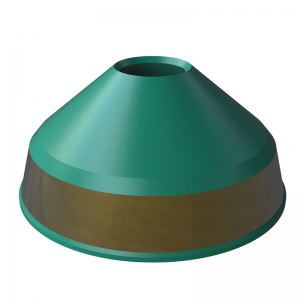
The 5013-6001 high-quality mantle wear part for the 4.25 ft cone crusher in abrasive mining duty
This mantle suits a mid-size secondary cone where the feed carries moderate silica, and it should be ordered against the machine serial so the profile matches the existing bowl liner.
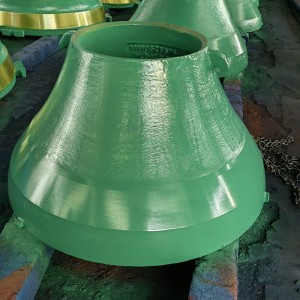
The HP500 cone crusher wear mantle part for mining equipment bowl and mantle replacement
The HP500 mantle runs in a high-throughput circuit where liner changeouts are planned around the monthly tonnage report rather than a calendar date.
The MM0528576 crusher wear mantle part for the GP220 cone crusher coarse chamber duty
The GP220 mantle suits a coarse chamber and should ship with the same heat number as the matching bowl liner so the two wear faces age together.

When do the support castings enter the alloy decision?
A mantle never runs alone, and the supporting rings decide whether the liner stays seated. The burning ring and the sealing ring absorb the axial load and keep dust out of the eccentric, so their alloy and fit matter as much as the liner itself. Order the support rings as a matched kit with the mantle so the reline does not stall on a single missing sealing component, and verify the ring bore within 2.0 mm of the drawing before the chamber is closed.
The 6380-8055 sealing ring crusher spare part for the 4.25 ft cone crusher backlash control
The sealing ring keeps abrasive dust away from the eccentric during the 60-90 day wear campaign, and its failure shows up first as elevated bearing temperature.
The 442-7115-01 burning ring suitable for the cone crusher SH4000 shaft sealing duty
The burning ring transfers the crush load into the main frame, and a correctly seated ring prevents the mantle from walking under a 500 t/h load. A support ring that arrives without the matching heat number forces the dealer to scrap the whole reline claim at audit, because the auditor reads the kit as one heat or rejects it.
What does a correct alloy specification look like?
Pull the decision into one written spec per machine. The spec that protects wear life names the grade by feed profile, sets the hardness and metallography acceptance, locks the support rings as a kit, and records the heat number on every liner. A dealer who buys on this discipline, instead of on the lowest quoted price per tonne, keeps the cone crusher availability above 95% across a 200000 tonne monthly plan and turns the liner purchase from a gamble into a measured cost per tonne.
Related Pages
- Cast Idler vs Forged Idler: Evaluating on Total Cost of Ownership
- Stable Supply of Excavator Track Shoes: Selecting a Reliable Partner
- Aggregate Equipment Wholesale Purchasing Guide
Post time: Nov-10-2026