Imported Jaw Plate Material Inspection Methods for Southeast Asian Mining Operators: Ensuring Product Compliance
In mining, aggregate production, and infrastructure stone processing operations across Southeast Asia, jaw crushers operate continuously under heavy loads. As core wear-resistant spare parts, jaw plates directly determine the downtime frequency, maintenance costs, and overall productivity of mining lines. For mining operators in Southeast Asia — facing long shipping lead times, high replacement costs, and complex on-site conditions — establishing a standardized, practical material inspection system for imported jaw plates is critical to avoiding substandard parts and ensuring stable equipment performance.
This article systematically explains the full-process inspection of imported jaw plates, from arrival verification to material performance testing, helping mining purchasers accurately judge whether products meet required standards.
I. Necessity of Jaw Plate Inspection for Southeast Asian Mining Imports
Southeast Asia has a wide distribution of mines processing granite, basalt, iron ore, gold ore, limestone, and other high-hardness, highly abrasive materials. Coupled with high-temperature, high-humidity, and dusty working environments, jaw plates require exceptional impact resistance, wear resistance, and deformation resistance.
Many mining companies rely on cross-border procurement with fragmented supply channels and large batch variations. Without professional material inspection, problems frequently occur:
non-compliant chemical composition, unqualified hardness, internal casting defects, and severely shortened service life.
These issues lead to early fracture, excessive wear, reduced crushing efficiency, even equipment failure, and costly production halts.
A standardized inspection process for imported jaw plates effectively controls quality, blocks unqualified parts, optimizes procurement costs, improves operational stability, and supports compliant management for large-scale mining enterprises.
II. Basic Inspection: Appearance & Dimensional Accuracy
Surface Quality Inspection
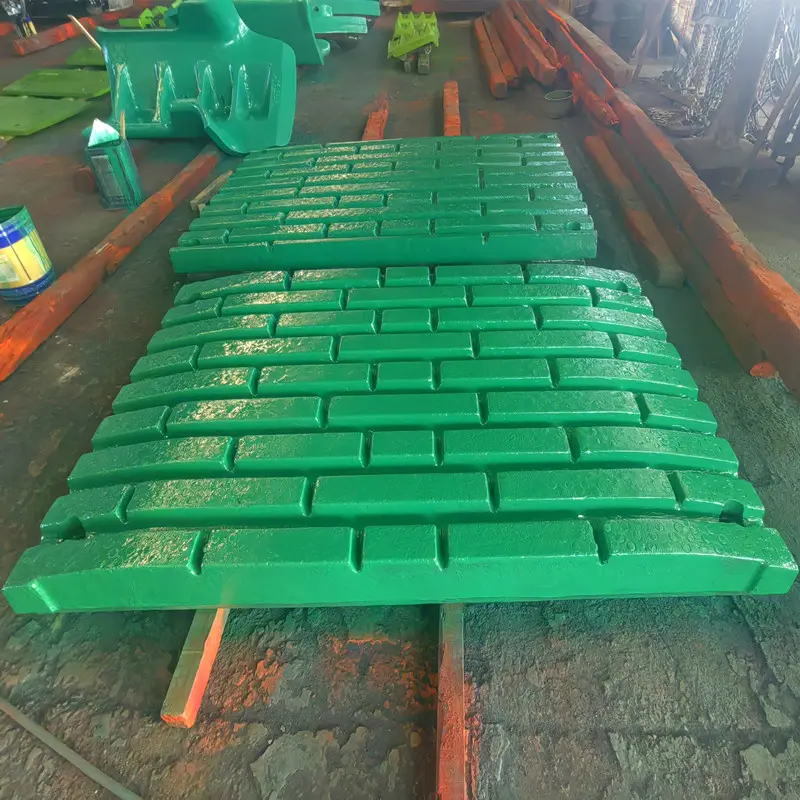
Check that the overall cast surface is smooth, free of visible cracks, blowholes, sand holes, shrinkage porosity, slag inclusions, burrs, or flash.
For high-hardness wear-resistant materials such as high-chromium iron and chromium alloy insert jaw plates, dense small surface pores drastically reduce wear resistance and increase fracture risk.
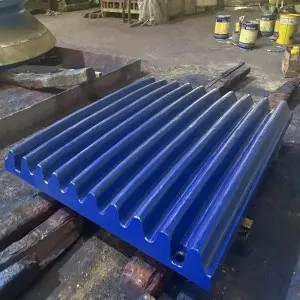
Also verify that tooth profiles are complete and uniform, with no notches or deformation at tooth roots, and no impact damage on the working surface.
Dimensional Accuracy & Fit Inspection
Verify key dimensions including length, width, thickness, mounting hole spacing, and tooth pitch according to crusher model specifications, with tolerances controlled within industry standards.
Focus on flatness of the mounting contact surface to avoid warping, ensuring tight fitting with the moving and fixed jaws. Excessive gaps cause vibration, loosening, or premature failure.
Marking & Batch Information Verification
Check material marking, production batch, heat treatment labeling, and other identifiers to ensure consistency with the purchase contract and material sheet.
This prevents mixed loading, misdelivery, or substitution of standard manganese steel or alloy steel with ordinary carbon steel.
III. Core Inspection: Chemical Composition Analysis
Wear resistance and impact resistance depend directly on chemical composition — the most common area for quality fraud in imports — requiring professional testing to confirm compliance.
Standard Manganese Steel Composition Inspection
Standard Mn13 jaw plates are tested for manganese, carbon, silicon, phosphorus, and sulfur.
Qualified Mn13 requires:
- Mn: 11%–15%
- C: 0.9%–1.4%
- Harmful impurities (P, S): < 0.07%
Out-of-range content results in poor work hardening and insufficient toughness.
High-Chromium Iron Composition Judgment
High-chromium iron offers superior wear resistance, with chromium as the key element:
- Cr15: ≥ 15% Cr
- Cr20: ≥ 20% Cr
- Cr26: ≥ 26% Cr
Verify balanced ratios of carbon, molybdenum, nickel, and other alloys to ensure uniform carbide distribution and extended service life.
Alloy Steel & Carbon Steel Differentiation
For alloy steel jaw plates, test Cr, Ni, Mo, Cu to confirm high-alloy performance.
For carbon steel plates, verify carbon content and strength grade to prevent substitution with low-carbon steel, which causes rapid wear and deformation.
TiC, Ceramic & Chromium Alloy Insert Inspection
For composite jaw plates with TiC particles, ceramic blocks, or chromium alloy inserts, inspect insert purity, distribution uniformity, and bonding strength with the base material to prevent detachment or insufficient hardness.
Composition testing typically uses a spectrometer for rapid on-site analysis, supported by laboratory chemical analysis for confirmation.
IV. On-Site Inspection: Hardness & Mechanical Properties
Hardness is the most direct indicator of wear resistance and the easiest performance test to conduct on-site.
Brinell & Rockwell Hardness Testing
Hardness standards vary by material:
- Water toughened Mn13: initial HB 200–250, work-hardened to over HB 500
- High-chromium iron: as-cast ≥ HRC 60
- Alloy steel: HRC 45–55
Take multi-point measurements on the working surface and average results to avoid non-uniform local hardness.
Toughness & Impact Resistance Evaluation
Insufficient toughness causes jaw plate fracture.
Standard manganese steel offers high toughness and impact resistance for high-impact ore crushing.
High-chromium iron provides high hardness but lower toughness, ideal for highly abrasive, low-impact conditions.
Verify via impact testing or small-scale trial to check for brittle fracture or chipping.
Wear Resistance Comparison Testing
Where possible, conduct small-sample wear tests simulating on-site impact and grinding to compare weight loss between batches; lower loss indicates better wear resistance.
V. Non-Destructive Testing for Internal Defects
Internal casting defects cannot be seen visually and require non-destructive testing (NDT) to prevent sudden failure during operation.
Ultrasonic Testing (UT)
UT detects internal shrinkage cavities, porosity, cracks, and inclusions, especially in thick sections and high-stress areas, ensuring dense structure and no strength-compromising defects.
Magnetic Particle or Penetrant Testing
For tiny surface cracks and folds, use magnetic particle testing (ferromagnetic materials) or penetrant testing to identify invisible surface defects and prevent crack propagation during operation.
VI. Installation Compatibility & Operational Compliance Verification
Even with compliant materials, final validation under actual Southeast Asian mining conditions is essential.
On-Site Installation & Commissioning
Perform no-load and load test runs after installation. Monitor stability, abnormal vibration, noise, and liner displacement. Verify discharge particle size to confirm cavity and tooth profile suitability for local stone characteristics.
Working Condition Matching Assessment
Match material to application:
- High-impact ore: standard manganese steel
- Highly abrasive aggregate: high-chromium iron
- Severe complex wear: TiC or ceramic composite jaw plates
Mismatch leads to short service life despite compliant composition.
Operational Wear Tracking
Establish service life logs for qualified jaw plates, recording operating hours, wear rate, and replacement cycles to build batch quality data for future imports.
VII. Summary of Quality Control for Imported Jaw Plates in Southeast Asian Mines
For Southeast Asian mining operators, material inspection of imported jaw plates is a complete system covering appearance verification, composition analysis, hardness testing, non-destructive testing, and operational matching.
Standardized inspection eliminates inferior parts, reduces equipment failure rates, cuts downtime, and significantly lowers long-term total operating costs.
Only by ensuring every batch of imported jaw plates has authentic materials, qualified performance, and stable quality can jaw crushers operate continuously and efficiently in the high-temperature, high-humidity, heavy-duty conditions of Southeast Asian mines, supporting stable productivity and profit.
#SoutheastAsianMiningJawPlateInspection #JawPlateImportMaterialTesting #StandardManganeseSteelJawPlateInspection #HighChromiumIronJawPlateQualityControl #AlloySteelJawPlateCompositionTest
Post time:
May-25-2026