
An excavator parts dealer collects a cone crusher mantle, a jaw plate and two undercarriage items from a mine under a credit note, and the warehouse cannot tell which pieces can go back on the shelf. A crusher wear part return like this is rarely worthless, but without a written grade the cone crusher mantle credit is argued over for weeks. A disciplined grading routine settles that argument in a single morning.
Why Does a Returned Wear Part Need a Formal Grade?
Returns arrive for many reasons: an over-delivered order, a liner taken off early during a reline, a machine swapped to a different model. Treating every cone crusher mantle credit as either full value or zero throws away money on both sides. A grade turns an argument into a record and tells the next customer what condition the part is in. A cracked liner sold as a spare will fail on the first shift.
That record also tells a heavy equipment fleet manager what came back and why. When a grade is disputed inside the 15-day claim window, a signed file is the only defence. A verbal description will not survive. Dealers who skip this step negotiate from memory, and memory favours whoever speaks last.
Which Eight Checks Decide a Returned Wear Part Grade?
A bowl liner inspection and a jaw plate check use the same eight points, in the same order, on the same form.
- OEM or part number, including identifiers such as 292819, 910031 and 706301429540, matched to the original order.
- Cast mark and heat number, photographed before the part is moved.
- Remaining thickness in mm at three marked points, compared with the as-new drawing.
- Wear pattern, noted as even, one-sided or localised.
- Crack check by dye penetrant on bolt seats and fillets.
- Bolt thread condition, checked with a gauge rather than by eye.
- Mating face, inspected for scoring, distortion and corrosion.
- Machine model, confirmed as GP300S, C125 or J-1175 where model-specific.
Eight points on every part, no shortcuts. A dealer who checks only the obvious faces misses the crack under a bolt seat. Sample 8 parts at AQL 2.5 for each returned lot.
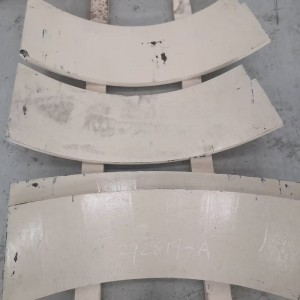
Start with the 292819-A and 292819-B protection plates for the Metso GP300S cone crusher, where the first step is the OEM part number check. The A and B positions are not interchangeable. Match the suffix before the plate is credited as a spare.
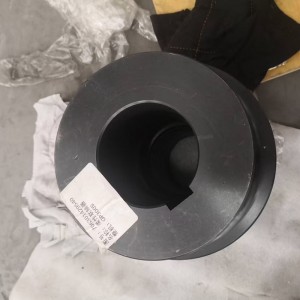
The 910031 pulley for the Metso C125 jaw crusher is graded on its cast mark. A re-machined pulley often carries the right catalogue number but a cast mark from a different batch. Treat a mismatched mark as a risk that the part was altered in service. Photograph it before the pulley leaves quarantine.
For the 706301429540 coupling jaw for the Metso C125 jaw crusher, the decisive check is the bolt thread. A stretched thread will not hold a safe clamp load a second time. Run a gauge through every hole instead of trusting a visual pass. A failure here means rework, not a ready-to-fit spare.
The carbon steel jawholder and pitman for the J-1175 and JW42 jaw crushers are judged on mating faces. A distorted face will not seat a new plate evenly, and the uneven seat shows up as premature wear. Check with a straightedge and feeler gauge, then classify as restock, rework or scrap.
The Wujing fixed and swing jaw plates in casting steel are graded on remaining thickness at three marked points. A minimum of 2 mm above the discard line separates rework from scrap. Below that line, no credit note makes the plate a spare.

Setting the Minimum Remaining Thickness
Thickness decides most grades, so it needs a stated threshold rather than a judgement call. Publish the discard line before the first return arrives. When dealer and mine agree in advance, grading becomes measurement instead of negotiation. Apply the same logic to every part family, even where the absolute figures differ, so the decision stays consistent across the pallet. Record the gauge used and the date it was last checked. An unverified reading is only an opinion. Two minutes with a gauge beats an afternoon of email.
When Does a Returned Liner Get Scrapped Instead of Credited?
A liner is scrapped when it fails on safety or geometry, not when it simply looks worn. A crack found by dye penetrant on a load-bearing seat cannot be graded as a spare. Three conditions send a part to scrap: a confirmed crack, thickness below the line, or a face that cannot be restored. Everything else earns a second look as rework.
How Should the Three-Band Decision Be Recorded?
Sort the sampled parts into three bands beside each part number.
- 1. Restock as spare: full thread, sound face, thickness above the line, no crack.
- 2. Rework for credit: needs a thread chase, face dress or new hardware.
- 3. Scrap: crack present, thickness below the line, or a face beyond repair.
Run the AQL wear parts check on each band and let the worst part set the lot. The wear part scrap grade is reserved for the third band.
Keeping the Grading File and the Claim Window
Hold the signed file with its photographs for 90 days. A file that cannot be produced on request is no better than none. Raise any disputed grade inside the 15-day claim window, while the pallet is intact and the measurements can be repeated. After that the steel moves on.
The conclusion is simple: grade every return against the same eight checks, publish the thickness line, and tie the result to a 90-day file. A crusher wear part return then becomes a stock decision, not an argument. The dealer who measures first settles the credit faster.

Related Pages
- Cast Idler vs Forged Idler: Evaluating on Total Cost of Ownership
- Stable Supply of Excavator Track Shoes: Selecting a Reliable Partner
- Aggregate Equipment Wholesale Purchasing Guide
Post time: Nov-26-2026