
A parts dealer in Kazakhstan sold a cone crusher liner set to a mining maintenance team and shipped it on time. Three weeks later the same customer called back, angry: the crusher was stripped down in the workshop, the main shaft was scored, the cover was cracked, and the machine was going to sit there for another five weeks waiting for parts that nobody had thought to order. The dealer had sold the wear parts correctly and completely. What the customer actually needed was a rebuild kit, and the dealer had not offered one.
This is the difference between selling crusher parts and supporting a crusher. When a cone crusher is opened, the wear liners are rarely the only thing that comes out of it. Shafts, covers, seals, drive components and fasteners are all exposed at the same moment, and the cost of discovering a second problem after the machine is already down is far higher than the cost of having the parts on the shelf.
Understand what “opening” a cone crusher actually exposes
A reline turns into a rebuild for predictable reasons. Once the head and the bowl are separated:
- The main shaft is visible and inspectable — scoring at the bearing journals, wear at the thread and any run-out are all measurable at this point and nowhere else.
- The cover and the seal surfaces are exposed — cracked covers and worn sealing faces are common findings on machines that have run long campaigns.
- The drive side is accessible — motor mount, coupling and pulley condition can be checked without a second teardown.
- Every fastener and filler ring is in hand — and missing one of them is the classic reason a rebuild overruns its window.
Dealers who treat these as separate enquiries create the five-week delay. Dealers who quote a rebuild kit avoid it.
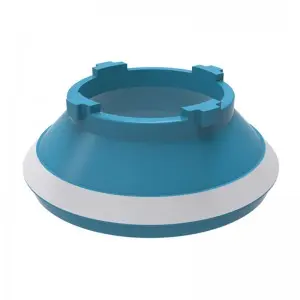
Build the kit around the machine model, not the part number
The single most useful thing a dealer can do is to keep a per-model rebuild list. For each machine model the dealer supports, the list should hold three tiers:
- Always replace — seals, gaskets, lock nuts, filler rings. Cheap, and never worth reinstalling.
- Inspect and likely replace — main shaft assemblies, covers, eccentric bushings.
- Inspect only, order if found — motors, drives and major castings, which are too expensive to hold speculatively but too slow to source after the finding.
The third tier is where the real money is lost. The answer is not to stock it; it is to agree the inspection findings list in advance so the order can be placed on day one of the teardown rather than on the day the problem is confirmed.
Main shaft assemblies: the item that stops a rebuild
A main shaft assembly is the highest-consequence spare in a cone crusher rebuild. It is heavy, it is slow to source, and a scored shaft cannot be reinstalled regardless of how good the liners are. It is also the item a customer is most likely to assume is fine, because shaft wear is invisible from outside.
The practical discipline is to quote the shaft assembly with every major liner order, marked as “subject to inspection”, so that the part is in the supply chain before the teardown rather than after it. A main shaft assembly covering the common mid-size cone crusher range is the type of spare that turns a five-week stoppage into a one-week one, and it is worth carrying against a known fleet of machines.
Where a dealer supports several units of the same model, the second shaft assembly should be treated as stock rather than as an order. A matched main shaft assembly held against a specific machine serial range is defensible inventory for exactly that reason: the machines exist, the wear is certain, and the alternative is downtime.
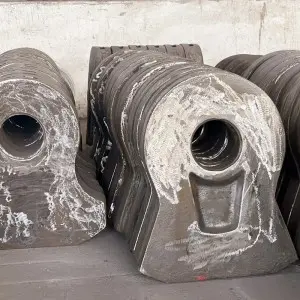
Covers: cheap, fragile, and always forgotten
Covers fail for unglamorous reasons — impact from a tramp event, a dropped tool, corrosion at a bolt face — and a cracked cover is a contamination path straight into the crusher’s lubrication system. A machine reassembled with a damaged cover will fail early, and the failure will be attributed to the liners.
Covers are also light, cheap relative to everything else in the kit, and easy to hold. There is no good reason to discover a damaged cover at reassembly. A cover built to the correct specification for a mid-size cone crusher belongs in the “always inspect, usually stock” tier, and it should be quoted with the liner set as a matter of routine.
Drive spares: the inspection that saves a second teardown
The motor and drive side is reachable during a rebuild and inaccessible afterwards without reopening the machine. Checking it during the rebuild is free; finding a problem three weeks later is not.
Motor condition, mount alignment and coupling wear should be on the teardown checklist, and the motor should be quoted as inspect-and-report rather than as a stock item. A drive motor specified for the same crusher model is a planned-order item: expensive enough that a dealer should not stock it speculatively, and slow enough that the customer cannot afford to find out about it late.
Wear parts: hold the grade that matches the feed
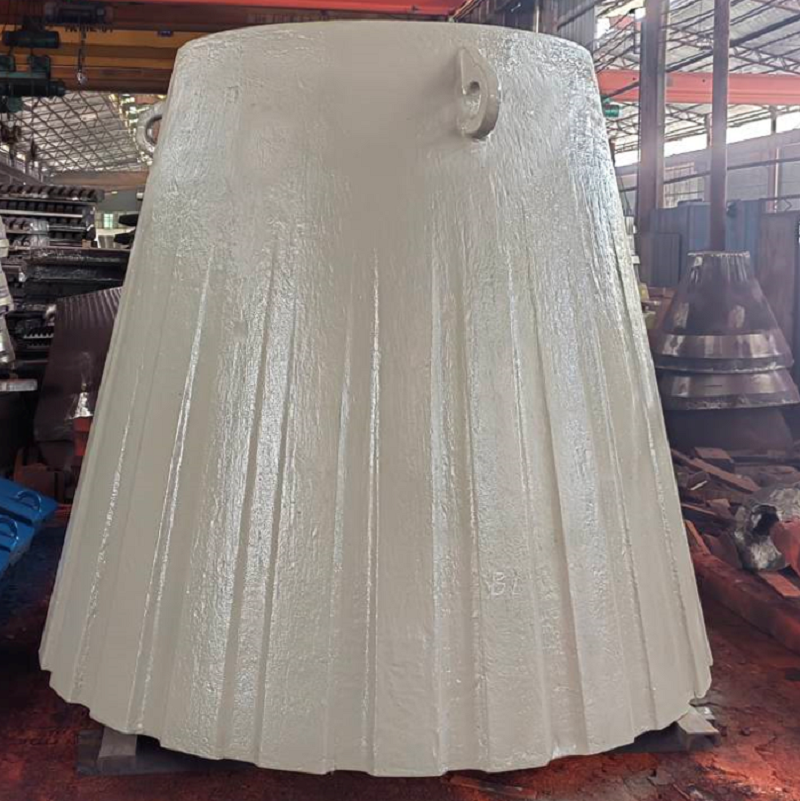
Finally, the liners themselves, and one point that dealers should state rather than assume: manganese grade is not interchangeable across applications. An 18 percent manganese wear part work hardens under impact and is the correct grade for hard, impact-dominated feed. In a fine, abrasive, low-impact duty it never reaches full hardness and wears faster than a harder alloy would.
Where the customer’s feed is hard rock with a large top size, an 18 percent manganese cone crusher wear part to a known OEM reference is the right specification, and the dealer should record the feed conditions alongside it so the next order is not a guess.
The rebuild kit checklist
- Machine model and serial range confirmed before quoting, not after.
- Always-replace items in the box with the liners: seals, lock nuts, filler rings, gaskets.
- Main shaft assembly quoted as subject to inspection, and stocked where the fleet justifies it.
- Covers inspected and usually held in stock.
- Drive side checked during teardown with a planned-order motor if findings require it.
- Wear grade recorded against feed conditions for the next campaign.
The conclusion
The Kazakhstan dealer did not lose that customer over a liner. The dealer lost five weeks of the customer’s production because the quote covered wear parts rather than a rebuild. Build a per-model kit, quote the shaft and the cover with every liner set, inspect the drive while the machine is open, and record the manganese grade against the feed. That is the difference between a parts supplier and a dealer a maintenance team calls first.
Related Pages
- Cast Idler vs Forged Idler: Evaluating on Total Cost of Ownership
- Stable Supply of Excavator Track Shoes: Selecting a Reliable Partner
- Aggregate Equipment Wholesale Purchasing Guide
Post time: Oct-21-2026