
The Crusher That Was Down for a Bushing
A quarry had its cone crusher down for eleven days. The mantle and bowl liner had been replaced on schedule in two days; the delay was caused by an eccentric bushing that nobody had in stock and that nobody had thought to order, because it was not on the wear parts list. Eleven days of lost production cost more than every wear part that had been replaced in the previous two years combined, and the part that caused it was a few hundred kilograms of bronze with a twelve-week lead time. This is the pattern across the industry: buyers plan meticulously for consumables and treat everything else as an emergency purchase. A crusher is a machine, not a set of liners, and the parts that stop it for weeks are precisely the ones that are not in the wear schedule.
Sort the Spares Into Three Lists
The first step is a classification exercise, and it takes an afternoon. List one: wear parts with a predictable consumption rate, ordered on a schedule. List two: service parts with a known replacement interval, ordered against hours run. List three: insurance parts with no schedule but a long lead time and a catastrophic consequence if unavailable. The bushing, the head assembly, the countershaft box guard and the hopper belong on the third list, and the third list is where a maintenance budget either saves or loses the year. Most operations have a well-managed first list and no third list at all.

Eccentric Bushings and Head Bushes: The Wear You Cannot See
These parts run in an oil bath and their condition is invisible until something goes wrong, usually as a temperature rise, a change in the oil analysis, or a metallic noise that nobody can locate. By the time a bushing failure becomes audible, the shaft it runs on is usually damaged too, and the repair moves from a part swap to a shaft repair or replacement. Two controls matter: regular oil analysis with trending rather than limit-checking, and a decision made in advance about the replacement interval. Specify the bushing by material and by the clearance it is machined to, not only by part number, because the clearance determines both the oil film and the running temperature. A properly specified replacement such as the eccentric bushing for HP3 cone crushers should be ordered against a known hours-run interval, should be ordered against a known hours-run interval.
Matched components should be planned at the same time. A head bush such as the head bush for MP1000 is inspected in the same outage as the eccentric bushing and rarely wears independently of it, so ordering one without the other simply buys a second shutdown.
Head Assemblies and Shafts: Plan the Heavy Intervention
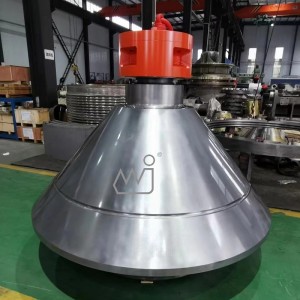
When a head assembly has to come out, the job is a major intervention with a crane, a long outage and a sequence that has to be right. Decide in advance whether you are replacing the assembly or rebuilding it, and make that decision before the outage rather than during it, because the two options have very different lead times and very different labour requirements. If the shaft and the seating surfaces are sound, a rebuild on the existing head can save weeks; if they are scored, no amount of new bushing will hold the clearance. Ask your supplier for the dimensional checks they need before quoting, and take those measurements during the last planned outage so the quotation is built on facts. A replacement assembly such as the head assembly for MP100 is a capital purchase and should be treated as one, with the specification, the inspection plan and the delivery window agreed months ahead.
Guards, Hoppers and the Parts Nobody Orders Until They Are Bent
Structural and guarding parts are treated as cosmetic until one is damaged, and then the crusher is unsafe to run. A missing or damaged guard on a countershaft or a drive is a safety finding, and a safety finding stops the machine immediately, which means a hundred-euro bracket can cost a week. Inspect guards and hopper liners at every liner change and photograph them, because the damage happens gradually and nobody notices the progression from bent to cracked. Keep the cheapest structural parts in stock; they are low-value and their absence is disproportionately expensive. A guard such as the countershaft box guard for MP800 belongs on the shelf rather than on a purchase requisition.
The same applies to feed components. A hopper such as the hopper for MP800 deforms slowly from impact and abrasion, and by the time the deformation is obvious the machine is usually being stopped for another reason entirely.
Fasteners and Small Parts: The Cheapest Downtime Insurance
Seals, washers, lock nuts, filler rings and bolts are individually cheap and collectively responsible for a surprising share of delays. A liner change that stops because a lock nut is missing is a planning failure, and it happens constantly. Build a consumable kit for each planned intervention containing every fastener and seal the procedure calls for, sourced against the machine’s parts manual, and replenish it after each use. Where the machine uses a specific fastener grade or a prevailing-torque nut, do not substitute a generic equivalent, because the torque behaviour is part of the design.
How to Buy These Parts Without Paying Emergency Prices
Buy insurance parts on a planned basis with a defined lead time, and accept that they will sit on a shelf. The correct comparison is not the cost of the part against zero, it is the carrying cost of the part against the cost of the outage it prevents, and on that comparison almost every insurance part justifies itself. Negotiate a stocking arrangement with your supplier: agreed part numbers, agreed holding quantity, and a call-off mechanism so you pay when you use it rather than when they ship it. That converts a capital line into an operating one and keeps the part within reach.
What to Put in the Spares Register
For every part on the third list, record four things: the part number and its verified cross-reference, the material and dimensional specification, the lead time from a named supplier, and the consequence if it is unavailable. Review the register once a year against the machines you actually run, because fleets change and registers do not. An operation with an accurate register spends less on emergency freight in a year than an operation without one spends in a single outage.

Related Pages
- Cast Idler vs Forged Idler: Evaluating on Total Cost of Ownership
- Stable Supply of Excavator Track Shoes: Selecting a Reliable Partner
- Aggregate Equipment Wholesale Purchasing Guide
Post time: Oct-08-2026