
1. Analysis Of Key Market Driving Factors In The Middle East, 2026
- Rising incremental demand from capacity expansion
With new quarries gradually put into production, initial assembly demand for manganese steel and high chromium iron jaw plates has increased dramatically.
- Upgrading trend of wear-resistant materials
Traditional single manganese steel materials can no longer meet high-efficiency production standards. More Middle Eastern customers are switching to composite alloy solutions, such as jaw plates reinforced with titanium carbide (TiC) and ceramic particles. Despite higher initial investment, these upgraded materials greatly reduce unit crushing operating costs.
2. Core Material Performance Comparison & Professional Selection Guidelines
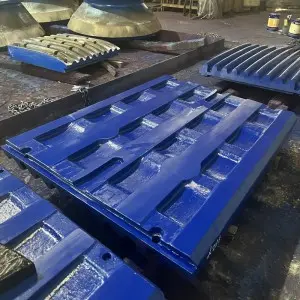
- Standard Manganese Steel Jaw Plates: Suitable for medium-hard rock crushing. It features outstanding toughness and resistance to fracture under strong impact, delivering the best cost performance for conventional working conditions.
- High Chromium Cast Iron Jaw Plates: Boasts ultra-high surface hardness and far superior wear resistance compared with manganese steel. However, it exhibits brittleness when encountering uncrushable objects such as iron blocks, ideal for highly abrasive aggregate with few impurities.
- Composite Wear-Resistant Solutions: Chrome alloy inserts and TiC-reinforced jaw plates have become premium choices for extreme working conditions. This rigid-flexible integrated design balances long wear service life and excellent structural impact strength.
3. 2026 Import Market Trend Predictions For Middle East Jaw Plates
- Growing demand for non-standard customized parts
Universal standardized jaw plates cannot adapt to minor equipment model differences. Importers prefer suppliers that provide customized spare parts for deep-cavity reversible hammer crushers and special vertical crushers to achieve precise inventory matching.
- Advanced supply chain layout & pre-stocking strategy
Affected by uncertain international logistics, Middle East aggregate enterprises are advancing procurement cycles ahead of schedule. Traditional on-demand purchasing is transforming into strategic inventory reserve, especially for complex alloy castings with long production lead times.
- Focus on Total Cost of Ownership (TCO) evaluation
Purchasing decisions no longer rely solely on unit prices, but unit crushing cost per ton of aggregate. Buyers are re-evaluating hidden costs caused by frequent downtime and replacement of low-cost carbon steel & ordinary alloy steel parts.
4. Scientific 2026 Jaw Plate Stock Quantity Calculation Model
Step 1: Confirm historical wear consumption coefficient
Count annual jaw plate usage volume. For example, if one pair of jaw plates is consumed monthly, annual basic consumption reaches 12 pairs.
Considering potential logistics delays and maintenance schedule restrictions caused by Ramadan and public holidays, it is recommended to add 30%–50% safety inventory on the basis of basic annual consumption.
- Regular daily inventory (40%): Standard manganese steel jaw plates for routine replacement
- Strategic reserve inventory (30%): High chromium iron and ceramic composite jaw plates for highly abrasive hard materials
- Emergency backup inventory (30%): Vulnerable parts for sand washing machines, feeders and vibrating screens, preventing main crushing line shutdown caused by auxiliary equipment failures
5. Practical Tips For Optimizing Middle East Aggregate Supply Chains
- Establish specialized material parameter archives
Build exclusive jaw material databases targeting different rock characteristics. Prioritize high-chromium materials for high-silicon rock; adopt improved high-manganese steel for high-soil-content and high-impact working conditions.
- Strictly control casting heat treatment processes
Heat treatment directly determines final service performance of alloy and carbon steel castings. Require suppliers to provide official heat treatment curves and metallographic structure reports to avoid premature failure caused by internal material defects.
6. Conclusion
By adopting high-performance wear-resistant solutions including TiC reinforcement and ceramic inserts, together with scientific safety inventory models, aggregate enterprises can effectively reduce production downtime risks and greatly improve overall operational efficiency.
Post time: Apr-20-2026