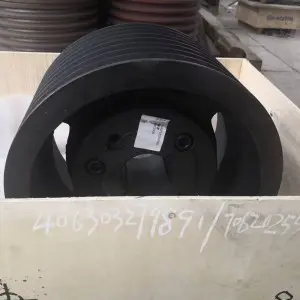
Procurement Advantages of C125 Flywheel Casting Parts for North American Aggregate Companies: Improving Crusher Operational Stability
In aggregate production operations, the jaw crusher serves as the core hub of the entire production line. For aggregate companies in North America, unplanned downtime of a C125 jaw crusher not only results in tens of thousands of dollars in direct production losses but also triggers a chain of downstream consequences, including delayed deliveries, contract breaches, and damaged customer relationships.
However, in most operations managers’ priority lists, wear parts directly involved in crushing — such as jaw plates and liners — usually take top priority, while the flywheel, a seemingly “static” component for energy storage and load balancing, is often underrated for its critical role in system stability.
This article is tailored for procurement and engineering managers at North American aggregate companies. It systematically analyzes the procurement advantages of C125 flywheel casting parts from five perspectives: technical principles, materials science, casting processes, supplier evaluation, and cost-effectiveness, providing a practical selection framework to improve crusher operational stability.
1. Core Role of the C125 Flywheel in Crusher Operational Stability
The working principle of jaw crushers creates highly periodic load characteristics: when the moving jaw approaches the fixed jaw for crushing, the system must overcome immense crushing resistance; during the return stroke, the load drops sharply.
Without a flywheel to regulate these periodic load fluctuations, the motor endures severe torque shocks, the entire machine generates excessive vibration and noise, and the fatigue life of key components is drastically shortened.
The C125 flywheel performs three core functions:
Energy Storage and Release
The primary function of the flywheel is to store energy during the crushing stroke and release it during the return stroke, smoothing motor load and preventing overload when crushing hard materials. A properly designed flywheel can reduce peak motor power demand by over 30%, extending the service life of the motor and drive system.
Load Balancing and Vibration Suppression
As a counterweight for the crushing mechanism, the flywheel compensates for reaction forces generated when crushing hard materials, preventing vibration damage to equipment and unsafe working conditions. A damaged or loose flywheel causes irregular crushing cycles and accelerated machine wear.
Smooth Start and Stop Support
The inertia of the flywheel ensures stable startup and shutdown. During startup, stored energy helps overcome initial resistance; during shutdown, gradual speed reduction avoids sudden system shocks.
For North American aggregate producers, the C125 is one of the most widely used models, forming a mainstream crushing lineup alongside C96, C106, C110, and C120 — covering primary to secondary and fine crushing. A typical
C125 flywheel weighs between 500 and 2000 kg, and its design and manufacturing quality directly impact line efficiency and maintenance costs.
2. Flywheel Casting Material Selection: Evolution from Gray Cast Iron to Ductile Iron
Casting material is the primary factor determining flywheel performance and service life. Material selection for the C125 flywheel requires a balance of strength, toughness, vibration damping, machinability, and cost.
Gray Cast Iron (HT250 / HT300)
Gray cast iron is a traditional choice for small to medium flywheels. It offers excellent vibration damping and machinability at a relatively low cost. However, it is brittle and has limited mechanical properties, making it prone to cracking under external impact.
For medium-sized crushers like the C125, gray cast iron may perform adequately under normal conditions but carries significantly higher crack risk during overload, blockages, or sudden shocks.
Ductile Iron (QT450-10 / QT500-7)
Ductile iron is the preferred material for large or heavy-duty flywheels. With tensile strength exceeding 450 MPa, it provides far greater toughness than gray cast iron, better resisting frequent torque shocks and centrifugal forces.
Its nodular graphite structure maintains vibration damping while drastically improving impact resistance. For C125 flywheels, ductile iron has become the industry standard.
Cast Steel
Cast steel is used in high-demand applications. Combined with lost-foam casting, high-quality cast steel minimizes internal porosity and inclusions, ensuring stable balance at high rotational speeds.
During material verification, buyers should require suppliers to provide complete Material Test Reports (MTR), including:
- Optical Emission Spectroscopy (OES) for chemical composition
- Tensile strength and impact toughness data
- Non-Destructive Testing (NDT) results for internal defects
These documents are essential to confirm compliance with design specifications.
3. Decisive Impact of Casting Process on Flywheel Reliability
The casting process directly determines internal density, dimensional accuracy, and dynamic balance performance. A high-quality C125 flywheel must meet strict standards in four stages: casting, heat treatment, machining, and dynamic balancing.
Casting Process
Most C125 flywheels use sand casting with resin or sodium silicate molds. Melting temperature is controlled between 1380°C and 1450°C, followed by aging heat treatment to relieve casting stress.
Lost-foam casting further reduces porosity and inclusions for more uniform structure. Proper transition fillet design is critical — undersized fillets cause stress concentration and cracking under load.
Machining Precision
Flywheel machining requires:
- H7 tolerance for bore dimensions
- Surface roughness Ra ≤ 1.6 μm
This ensures proper fit with the eccentric shaft: overly tight clearance causes installation difficulty and thermal stress; excessive clearance leads to vibration and shock. Chamfers on the hub outer diameter avoid machining stress concentration.
Dynamic Balancing Testing
The flywheel must achieve a dynamic balance grade of G6.3, with residual unbalance below 10 g·cm.
Unbalanced flywheels create periodic centrifugal forces at high speeds, increasing fatigue loading on bearings and main shafts, and may even cause machine resonance.
Buyers should require a dynamic balance test report to confirm acceptable residual unbalance before installation.
Quality Control System
A complete QC process includes:
- Chemical and mechanical property testing
- MT / UT inspection for casting defects
- Dimensional tolerance verification
- Final dynamic balance validation
These measures ensure reliable high-speed operation, with a design service life of 8 to 10 years.
4. Supplier Evaluation: A Quality Assurance System Beyond Price
For procurement teams at North American aggregate companies, supplier evaluation must extend beyond price comparison to a comprehensive quality framework.
Casting Capability Verification
Qualified flywheel suppliers must possess full production capabilities:
- Medium-frequency induction furnaces
- Heat treatment furnaces
- CNC machining centers
- Dynamic balancing equipment
Production scale and quality systems directly determine consistency and reliability. Suppliers should be proficient in carbon steel, alloy steel, high manganese steel, and high-chromium iron to support material flexibility.
Quality Certifications and Testing Standards
ISO 9001 certification confirms process control and continuous improvement.
Suppliers should also provide independent third-party test reports for chemistry, mechanical properties, and NDT.
For the North American market, parts must comply with ASTM material standards and relevant safety regulations.
Supply Chain Reliability and Delivery Capacity
Flywheel failure often halts entire production lines. Key procurement factors include:
- Stock availability
- Production lead time
- Logistics responsiveness
Standard lead times are 4–6 weeks, with expedited orders in 2–3 weeks. Suppliers with local North American warehousing reduce delivery times and cross-border logistics risks.
Technical Support and Customization
Leading suppliers offer reverse engineering and custom production from samples or CAD drawings.
Custom options include material grades, surface finishes, marking, and design optimization based on field performance. This collaboration extends flywheel life under specific operating conditions.
5. Cost-Benefit Analysis: Balancing Quality Investment and Operational Risk Control
As a non-wearing component, flywheel procurement is often viewed as a one-time expense. However, from a Total Cost of Ownership (TCO) perspective, the hidden costs of low-quality flywheels far exceed purchase price differences.
Direct Cost
Indirect Cost — Downtime Loss
This is the decisive financial factor. Industry data shows:
- A 500 TPH crusher loses approximately $5,000 per hour of downtime
- A full 8-hour shift can cost $40,000 in lost profit
If downtime causes secondary damage — such as bearing failure or bent main shaft — repair costs can reach:
- $250,000 in parts
- $50,000 in labor and rental equipment
- Three days of lost production (≈30,000 tons)
Total losses often approach $500,000.
While flywheel failure is less common than bearing or shaft issues, the consequences are severe. Cracks or breakage cause irregular loading, accelerate fatigue on bearings and shafts, and speed wear of other critical components.
Hundreds of dollars saved on a flywheel can lead to hundreds of thousands in future repair and downtime costs.
Indirect Cost — Labor and Maintenance
Low-quality flywheels require more frequent inspections, shorter replacement cycles, and higher maintenance labor. A well-designed, properly balanced flywheel with routine checks minimizes maintenance demands, freeing teams for high-value preventive work.
Total Life Cycle Perspective
Industry data shows spending on wear parts and aftermarket components continues growing. North America accounts for 32.8% of the global wear parts market, with crusher wear parts representing 37.5% of that share.
In this environment, procurement teams should adopt a quality-over-price principle and integrate flywheel and key casting selection into equipment life-cycle cost management.
Conclusion
The flywheel of the C125 jaw crusher is not a secondary component — it is the energy hub connecting power input and crushing action, core to vibration suppression, load balancing, and stable machine operation.
For procurement and engineering managers at North American aggregate companies, mastering flywheel technology, materials, casting processes, and supplier standards is foundational to building operational competitive advantage.
Amid continued global aggregate market expansion:
- 2025 global market size: $620 billion
- Projected 2034 size: $809 billion
- North America: 4.8% CAGR, one of the fastest-growing regions
Demand for equipment stability and efficiency continues rising. Upgrading flywheel selection from “reactive replacement” to “proactive optimization” allows operators to benefit in cost control, production continuity, and equipment lifespan management.
Investing in high-quality flywheel casting parts is ultimately an investment in a more reliable and predictable production line.
#C125 jaw crusher flywheel #jaw crusher flywheel casting #gray cast iron HT250 HT300 #ductile iron QT500-7 #jaw crusher flywheel dynamic balancing #crusher spare parts procurement #aggregate equipment maintenance #jaw crusher vibration reduction #flywheel material selection #jaw crusher downtime cost
Post time:
Mar-31-2026