
“Pairing Replacement” principle: Why do movable and fixed jaw plates, concave surfaces and backing plates need to be replaced simultaneously?
During the operation and maintenance of the crusher, the scientific nature of parts replacement directly affects the equipment’s production capacity, operational stability and service life. Among them, the “pairing and replacement” of the movable jaw plate and the fixed jaw plate, as well as the concave liner plate and the matching liner plate, is a key principle recognized in the industry but often overlooked. Many enterprises, in an attempt to save short-term costs, replace single-side components separately, which instead leads to a sharp increase in later operation and maintenance costs. This article starts from the component collaboration logic, dissects the core reasons for “pairing and replacement”, and helps you avoid operation and maintenance misunderstandings.
Core logic: The “running-in and symbiosis” feature of paired components
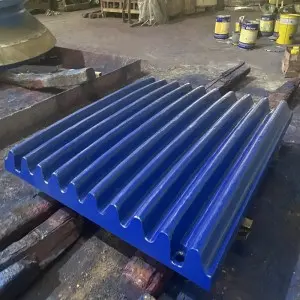
The crushing function of the crusher relies on the precise fit of the paired components. The movable jaw plate and the fixed jaw plate, as well as the concave surface and the liner plate, will form stable running-in surfaces during long-term operation. Take the jaw crusher as an example. The moving jaw plate moves back and forth along the eccentric shaft, and together with the fixed jaw plate, they exert squeezing and shearing forces on the material. After long-term operation, the contact surfaces of the two will form a fitting wear trajectory. This “symbiotic” state is the basis for ensuring the crushing efficiency.
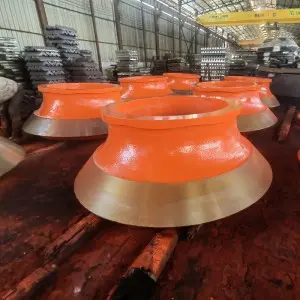
Similarly, the concave liner and the moving cone liner of the cone crusher achieve layer-by-layer crushing of materials through the gradually changing cavity shape during high-speed rotation. The dimensional accuracy and wear degree of the paired components always remain in sync. The original design intention of these crusher parts is to work in coordination. Only by maintaining paired replacement can this precise coordination relationship be sustained, avoiding the disruption of the crushing rhythm of the equipment due to the wear difference between new and old parts on one side.
The hidden risks of individual replacement: dual hazards of cost and safety
Ignoring the “paired replacement” principle and replacing single-sided accessories alone can trigger a series of chain problems. Firstly, the crushing efficiency has dropped significantly. The wear deviation between new and old components will lead to uneven gaps in the crushing cavity and unbalanced force on the materials. This not only reduces the output but also results in a large amount of substandard particle size materials, increasing the cost of rework.
Secondly, it accelerates equipment wear and tear. The hardness and flatness of the new parts on one side do not match those of the old parts, which will cause the force to be concentrated in a local area. The old parts that have not been replaced will experience abnormal wear due to a sudden increase in load, and may even cause damage to core components such as bearings and eccentric shafts. The originally intended cost savings on parts may eventually turn into high major repair costs. More importantly, there are potential safety hazards. Uneven force distribution may lead to intensified vibration during equipment operation. In severe cases, it may cause loosening or detachment of components, threatening the safety of on-site operations.
Key points for practical operation: Core precautions for pairing and replacement
When following the “pairing and replacement” principle, two core points need to be grasped. First, make sure to pair accessories of the same specification. Even if the model labels of different batches and materials are the same, there may still be slight dimensional deviations. It is recommended to choose matching accessories of the same standard to ensure that the gap of the crushing cavity meets the equipment requirements after installation.
Second, calibration should be carried out promptly after replacement. After the installation of the paired accessories is completed, the gap of the crushing cavity and the parallelism of the components need to be precisely calibrated to avoid abnormal wear of the new accessories due to installation deviations. In addition, during daily operation and maintenance, the wear status of the paired components should be inspected regularly. When the wear reaches the threshold specified in the equipment manual, the pairing replacement process should be initiated promptly to prevent the expansion of the damaged component range due to delayed replacement.
For industries such as mining and building materials that rely on continuous operation of crushers, the scientific nature of parts replacement directly determines production efficiency. The “paired replacement” of the movable jaw and the fixed jaw plate, as well as the concave surface and the backing plate, may seem to increase the cost of a single replacement, but in fact, it optimizes the long-term operation and maintenance costs by ensuring the operational efficiency of the equipment and reducing subsequent wear and tear. Only by mastering this core principle can the operation and maintenance of the crusher be more efficient and economical, laying a solid foundation for continuous production.
Post time: Dec-18-2025