
Over the years of making crusher parts, I often hear the on-site workers complain that when hammer heads and other vulnerable parts are exposed to high-intensity working conditions, they wear out as quickly as if they were in a rush to meet deadlines. Just a few days after they are installed, the working surface becomes concave or has a corner chipped. The machine can be shut down and then sent back to the factory for processing, but the schedule waits for no one. Especially in some remote sand and gravel yards and mines, not only is the cost of transportation and repair high, but the back-and-forth trouble and delayed work are even more troublesome than the parts themselves. Therefore, the skill of on-site surfacing welding repair has gradually become an “emergency compulsory course” for many teams.
The core logic of surfacing repair is not difficult to understand: using welding materials to “grow” a new wear-resistant layer on the worn area, restoring its bite force and impact resistance similar to that of a new part. But when it comes to actually doing it, it’s not as simple as just following the procedures in the manual. The wear patterns of the hammer heads are diverse. Some are only worn thin on the surface, some have deep pits or even cracks, and some are accompanied by fatigue of the base material. Depending on the situation, the preheating temperature, welding material selection, and bar movement techniques all need to change accordingly.
Let’s start with the preparatory work. Many people are in a hurry to start welding but neglect the cleaning and preheating of the base material. After long-term use, the surface of the hammer head may be contaminated with oil stains, mineral powder, and even embedded with crushed material particles. If not cleaned thoroughly, the weld layer and the base material are prone to “false adhesion”. The preheating step is particularly crucial in open-pit mines in northern winters – the ambient temperature is low, and the hammer head body is cold and hard. If directly welded onto it, stress concentration will occur, and the weld layer is prone to cracking. We usually heat the temperature on site slowly with an oxygen-acetylene flame to 150 to 200 degrees Celsius, and measure it with a thermometer pen while baking to ensure that the overall temperature difference is too large.
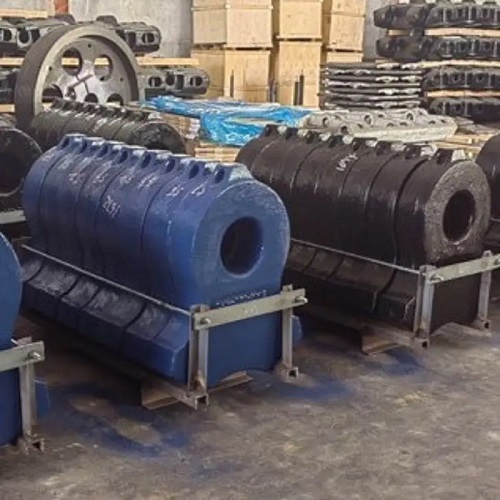
Matching welding materials is a meticulous job. The common base materials for hammer heads are high manganese steel or alloy steel. The surfacing layer should take into account both hardness and toughness; otherwise, it will either be too brittle to break at the slightest touch or too soft to be used. The commonly used welding wires or electrodes on site are mostly high-manganese alloy series containing chromium, molybdenum and vanadium. Such materials can enhance wear resistance while maintaining a certain degree of toughness. However, it should be noted that the hardness requirements vary under different working conditions – for instance, when processing granite hammer heads, the wear is mainly caused by cutting, and the weld layer can be slightly harder. If large pieces of ore are frequently crushed and the impact force is strong, the toughness of the weld layer must be given priority; otherwise, it is easy for the pieces to fall off.
The welding technique directly affects the forming quality. Surfacing welding emphasizes “thin and multi-layer”. If the surfacing is too thick at one time, the accumulation of heat will cause uneven contraction of the weld seam, posing a risk of cracking. The speed of the strip movement should be stable to ensure the uniform spread of the molten pool, especially in the edge transition zone, where the arc should be gradually reduced to avoid steep notched weld beads – these protrusions can easily be “gnawed” off by the material during subsequent operation, creating a new starting point for wear. When encountering deep pit-type wear, the base layer can be filled and leveled first, and then piled up layer by layer. It is best to leave a small cooling interval between each layer to allow the stress time to be released.
The slow cooling after the repair is completed cannot be omitted either. Especially in mining areas with large temperature differences between day and night, such as the northwest Gobi or plateau regions, after welding, do not rush to expose the hammer head to cold air. Wrap it with asbestos cloth or thermal insulation cotton and let it naturally cool to room temperature. This can minimize the microscopic cracks caused by rapid cooling to the greatest extent. After that, it is best to conduct a simple tap check – gently tap the surface of the weld layer with a small hammer, listen to whether the sound is dull or clear, and see if there are any signs of peeling. If necessary, repair the weak points of the weld.
Working on site, the environment and conditions are often not perfect, but this also forces us to figure out more practical skills. For instance, in the humid southern quarries, special attention should be paid to dehumidification before welding to prevent porosity. In a dusty construction site, setting up a temporary windbreak can significantly improve the quality of weld seams. For worn parts like hammer heads, surfacing repair is not a panacea, but it offers a flexible option on site – no waiting, no delay in work, and minimizes downtime. For sand and gravel lines or mines that require continuous operation, this value is sometimes more substantial than replacing parts.
Ultimately, surfacing repair tests not only technical skills but also an understanding of the working conditions and patience with the details. By mastering the key steps of preheating, material selection, welding and slow cooling, the worn parts can be put into another round on site, which not only ensures production efficiency but also makes the life cycle of the accessories more fully utilized.
Post time: Dec-08-2025