
Not just gaskets: The philosophy of stress distribution optimization of flat gaskets in crusher assembly
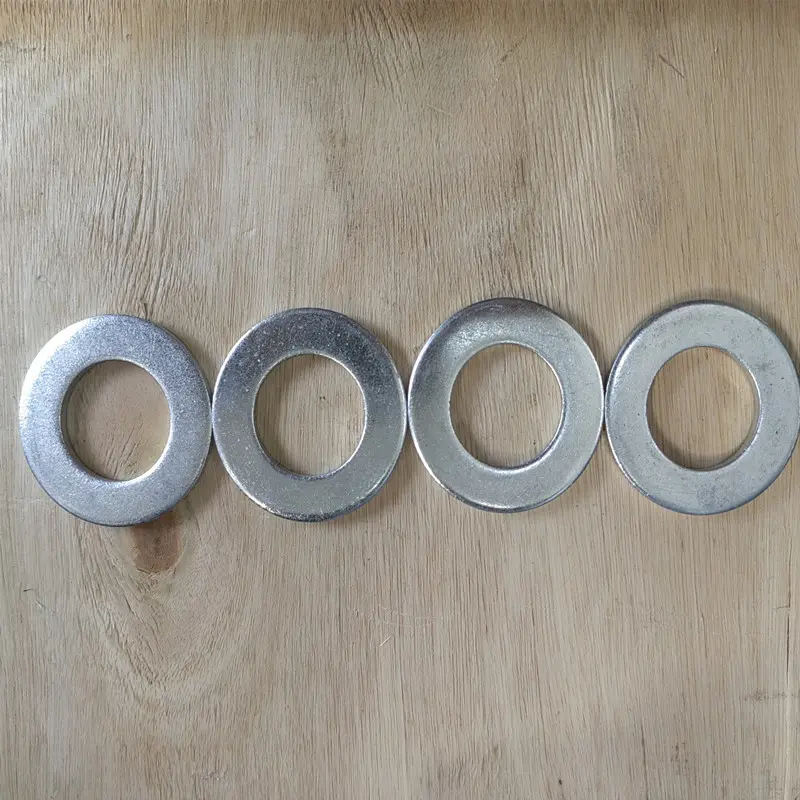
In the maintenance workshop of the crusher, in the face of huge rotors, heavy liners and complex bearing assemblies, flat washers may be one of the most inconspicuous parts. On the purchase list, it is often just an additional item behind the bolt. However, for engineers and maintenance managers who truly understand the lifespan and operational stability of equipment, the role of this small ring is by no means as simple as a “filler”. It is a precise mechanical bridge, with the core mission of optimizing stress distribution to safeguard the integrity of the entire assembly.
The Harsh World of Crushers: Why Stress Distribution Is Crucial
Whether it is a jaw type, a cone type or an impact type, the essence of a crusher’s operation is to continuously engage in strong confrontation with high-hardness materials. This kind of confrontation generates huge and repeated impact loads and vibrations. These forces will be transmitted between metal components through parts such as bolt connections.
If the stress distribution is uneven, several fatal problems will arise:
Plastic deformation at the connection point: Local stress exceeds the yield strength of the material, causing the contact surface to be crushed and resulting in a permanent depression.
Bolt fatigue failure: Uneven loads can cause some bolts to bear tensile forces far exceeding the designed ones, leading to premature fatigue fracture.
Fretting wear of mating surfaces: Under vibration, the slight relative movement between contact surfaces can cause severe wear and corrosion, damaging assembly accuracy.
Seal failure: The flange surface warps due to uneven force, causing the sealing gasket to fail and leading to problems such as oil leakage.
At this point, a precisely calculated and selected flat washer becomes the first line of defense against these problems and also an economically effective one.
The three stress distribution optimization mechanisms of flat washers
1. Expand the pressure-bearing area: Reduce surface pressure
This is the most fundamental and important function of the flat washer. The bottom surface area of the bolt head or nut is limited. When tightening generates a huge preload force, this small contact surface will bear extremely high pressure (pressure per unit area). Especially on softer materials (such as certain aluminum alloy components or quenched and tempered steel surfaces), it is very easy to cause indentations.
The flat washer disperses the tightening force of the bolt over a broader circular area through its larger outer diameter. This directly reduces the pressure at the contact surface, protects the surface of the connected parts, and prevents the loss of preload and loosening of the connection caused by local crushing. This function is crucial for maintaining a long-term stable clamping force at the joint surface of the crusher box, the fixation of the liner plate and other parts.
2. Fill uneven surfaces: Achieve uniform contact
The ideal machining plane is also undulating at the microscopic level. When two rough surfaces are pressed together by bolts, what actually comes into contact are only some raised peak points. This leads to a high concentration of stress at these discrete points.
A flat washer with moderate material hardness and high surface flatness can serve as both a “filling layer” and a “transition layer”. It can to a certain extent, attach and fill the microscopic unevenness of the connected surface, promoting the transition of contact from “point contact” to the more ideal “surface contact”. More uniform contact means more uniform stress transmission, avoiding early cracks caused by local stress concentration.
3. Correct angular deviations and provide buffering
During assembly, situations where the bolt axis is not completely perpendicular to the support surface occur from time to time. Without a washer, the nut or bolt head will contact the surface at an inclined Angle, causing the stress to be completely concentrated on one side of the edge, which is extremely dangerous.
Flat washers, especially those made of materials with certain toughness and plasticity (such as high-quality low-carbon steel after heat treatment), can undergo slight adaptive deformation during the tightening process, compensating for this angular deviation and allowing the load to be transmitted more perpendicularly along the bolt’s axis. Meanwhile, its tiny elasticity also provides a bit of beneficial buffering for withstanding the unique impact load of the crusher, avoiding pure rigid impact.
Choosing Flat Washers for Crushers: Thoughts Beyond Standard Parts
After realizing that the core function of flat washers is to optimize the stress distribution, their selection can no longer be simply “applied” according to the bolt specifications. For heavy-duty equipment like crushers, the following dimensions should be considered:
Hardness matching: The hardness of the washer should be between that of the bolt and the connected part. Too soft (such as ordinary thin iron sheet) is prone to deformation and failure. If it is too hard, it may damage the contact surface. Generally, washers are required to have a certain surface hardness to resist embedding, while maintaining toughness in the core.
Dimensional accuracy and flatness: The precision of the outer diameter/inner diameter and the parallelism of both sides are crucial. Inaccurate dimensions can lead to poor centering, while poor flatness will introduce new stress unevenness. This is particularly important for the assembly of rotor components with high dynamic balance requirements.
Material and coating: In addition to standard carbon steel, in damp or corrosive working conditions, stainless steel or galvanized gaskets may be required to prevent rust and jamming. Surface treatment also affects the coefficient of friction, which in turn influences the conversion efficiency of preload.
Thickness consideration: When it is necessary to compensate for larger gaps or reserve space for elastic deformation, thicker washers may be required. However, excessive thickness may introduce instability and requires a comprehensive assessment.
Conclusion: Incorporate small parts into the management of the large system
In the reliability engineering of crushers, every connection point is a potential weak link. The value of the flat washer lies in its ability to transform this weak point into a stable and reliable structural unit by optimizing the stress distribution. It ensures that the preload of the bolts is effectively and evenly converted into clamping force, resisting vibration and shock, and protecting the more expensive core components.
Therefore, for professionals responsible for the long-term stable operation of equipment and the control of maintenance costs, re-examining this “small parts list” and specifying the appropriate flat washers from the perspective of stress management is a highly cost-effective technical investment. It embodies a systematic and meticulous philosophy of equipment management – true sturdiness stems from the harmonious transmission of force at every point.
Post time: Dec-16-2025