
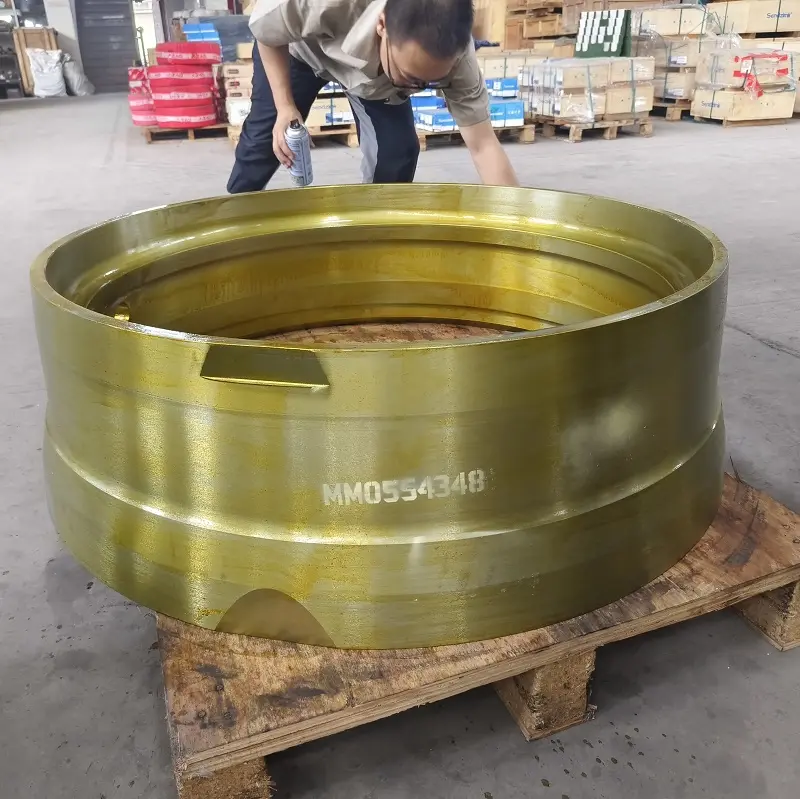
Middle cone: A key connecting component for multi-layer crushing efficiency
In the multi-layer crushing process, whether the upper and lower crushing units of the crusher can precisely coordinate and whether the materials can flow smoothly directly determine the overall production capacity and crushing effect. The Intermediate Cone, as the connecting core component, is by no means a simple structural connecting piece – it undertakes multiple missions such as force transmission, material guidance, and structural positioning, and is the “invisible core” that ensures the continuous and efficient operation of multi-layer crushing.
Many people tend to underestimate the role of the middle cone, thinking that it is merely a “transitional component” for transporting materials. However, in actual operations, multi-layer crushing requires that the crushed materials from the upper layer precisely enter the lower cavity. At the same time, it is necessary to ensure the stability of power transmission and avoid vibration or uneven loading. The middle cone precisely meets these two major demands: on the one hand, its inner wall curvature and opening design directly guide the material flow trajectory, avoiding uneven crushing caused by material accumulation, material jamming or uneven loading. On the other hand, as a key to structural connection, it is necessary to precisely position the coaxiality of the upper and lower broken parts to ensure uniform power transmission and reduce vibration loss during equipment operation.
The core value of the middle cone lies in balancing “efficiency” and “stability”. In high-intensity crushing scenarios, the impact load of the material will be transmitted to the middle cone through the upper crushing components. If its structural strength is insufficient or the positioning accuracy is not good enough, it is very likely to deform and loosen, which in turn will lead to disordered feeding in the lower crushing chamber and intensified equipment vibration. This not only reduces the crushing efficiency but may also trigger a chain of damages – such as excessive wear of the liner and main shaft deviation, ultimately leading to unplanned shutdowns and increasing maintenance costs.
The key factors influencing the performance of the middle cone lie in the detailed design and manufacturing process. Material selection is fundamental. It needs to be compatible with the hardness and impact strength of the crushed materials. Usually, high-strength wear-resistant alloys are adopted, and through precise heat treatment, the impact resistance and deformation resistance are enhanced. In terms of structural design, a reasonable wall thickness distribution, smooth inner wall transitions, and precise installation positioning holes can reduce stress concentration points and prevent fatigue damage under long-term stress. And processing accuracy is even more crucial. Even minor deviations in coaxiality and surface roughness can lead to unstable operation of the equipment after assembly and weaken the synergistic effect of multi-layer crushing.
For production lines that rely on multi-layer crushing processes, the quality of the middle cone is directly related to three core indicators: production capacity, energy consumption and maintenance frequency. The reliable quality middle cone can make the material flow more smoothly, reduce ineffective energy consumption and increase the crushing volume per unit time. At the same time, it reduces the number of shutdowns caused by component failures, and decreases the inventory of spare parts and the workload of maintenance. More importantly, it can ensure uniform particle size of the crushed products, avoid fluctuations in the quality of the finished products caused by disordered feeding, and lay a foundation for subsequent processes.
In the current pursuit of efficient production, behind the “connecting part” identity of the middle cone lies the “collaborative hub” function of the multi-layer crushing system. Ignoring its quality may seem to save short-term procurement costs, but in fact, it may result in a higher long-term cost due to reduced efficiency and increased maintenance. Emphasizing the selection and quality control of the intermediate cone is essentially to build a stable operational foundation for the multi-layer crushing process, enabling each crushing unit to fully exert its efficiency.
Whether it is mining, building materials processing or metallurgical raw material handling, the Intermediate Cone has always been an indispensable key component of the multi-layer crusher. With precise structural design and reliable performance, it makes the crushing process smoother and the operation more stable, becoming an important guarantee for improving the overall production efficiency.
Post time: Dec-22-2025