
In-Depth Analysis of Crusher Spare Parts Casting Processes: How to Choose the Most Cost-Effective Production Method?
A set of moving jaw plates for a jaw crusher, produced using different casting processes, can exhibit a service life difference of over three times—behind this figure lies the cost-benefit trade-off every purchaser must confront.
When procuring hammer heads for hammer crushers or bowl liners for cone crushers, have you ever been baffled by suppliers’ varying quotes citing different “casting processes”? Lost foam castings offer tempting prices but raise strength concerns, while resin sand castings deliver stable performance at significantly higher costs. This selection dilemma plays out daily in global mining machinery component procurement.
Today, from a frontline foundry engineer’s perspective, I will thoroughly explain the true strengths and weaknesses of the three mainstream casting processes: lost foam, water glass sand, and resin sand. After reading this article, you will be able to precisely match the process to your component requirements, controlling procurement costs while ensuring stable equipment uptime.
Lost Foam Casting: A Cost-Effective Solution for Complex Structures—But Is Strength Really Its Weakness?
The greatest advantage of lost foam casting (also known as V-process casting) lies in its ability to achieve one-step molding of complex geometries at extremely low cost—a boon for crusher components featuring curved surfaces or internal cavities. The principle is straightforward: create a precise foam plastic model of the part, embed it in dry sand and compact it, then directly pour molten iron. The foam vaporizes instantly upon contact with the high-temperature metal, replaced by the molten metal to form the casting.
In the crusher component sector, lost foam casting is particularly suited for producing complex parts like impact crusher blow bars, jaw crusher liners, and non-critical housing components. Last year, when we manufactured a cone crusher feed hopper for a Southeast Asian client using this method, we not only reduced the delivery cycle from 45 to 28 days but also cut the unit cost by approximately 15%.
But is the industry-wide claim that “lost foam castings have low strength” truly accurate? This is actually a misconception. Strength variations primarily stem from two factors: first, if gases released during foam vaporization are not properly vented, they can form porosity defects in the casting; second, the slower cooling rate of dry sand may lead to coarse grain structures in the casting. Nowadays, through optimizing the pouring system, using low-gas-emission foam materials, and adding alloying elements, it is entirely possible to produce qualified components that meet the operational requirements of small and medium-sized crushers.
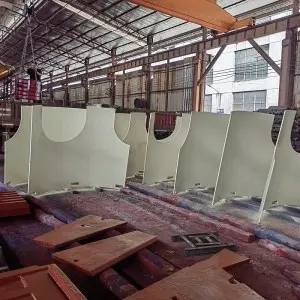
Water Glass Sand Casting: An Economical Traditional Choice—How to Solve the Precision Challenge?
Water glass sand casting stands as the “cost-effective veteran” in mining machinery components, particularly suited for mass-producing relatively simple wear-resistant parts like crusher liners and screen bars. Its core advantage boils down to two words: affordability. Water glass (sodium silicate) serves as an extremely low-cost binder, and the recycling process for used sand is relatively straightforward, making it highly suitable for large-scale production.
One case study stands out: a major domestic cement plant required nearly a thousand hammer mill hammer heads annually. Initially using resin sand casting, their per-unit costs remained high. We recommended switching several rows of slower-wearing hammers to water glass sand casting. While maintaining service life, this reduced batch procurement costs by 22%.
However, surface finish and dimensional accuracy remain significant challenges for water glass sand castings. Due to the material’s minimal shrinkage allowance after hardening, thermal cracking often occurs during casting contraction. Additionally, sand adhesion on the casting surface makes cleaning extremely labor-intensive. The industry’s common solutions involve adding modifiers to improve溃散性 (collapse properties) or applying specialized coatings to the mold surface during pattern making. For many non-critical load-bearing components, this level of surface roughness is entirely acceptable.
Resin Sand Casting: The King of High-Precision Wear Parts—Is the High Cost Worth It?
When procuring critical load-bearing components like main shaft bushings for cone crushers or moving jaw bodies for large jaw crushers, resin sand casting is often the only reliable choice. This process uses synthetic resin as a binder, yielding high-strength, high-precision sand molds capable of producing castings with machined-like surface finishes and dimensional tolerances under 0.3%.
The most compelling comparison comes from our parallel testing: for identical high-manganese steel crushing liners, resin sand castings demonstrated an average service life 30-40% longer than water glass sand castings. This advantage stems from the denser internal structure of resin sand castings, which rarely exhibit shrinkage cavities or porosity—critical properties for crusher components enduring massive impact loads. Naturally, this premium quality comes at a cost—resin sand castings typically cost 25-35% more than water glass sand castings.
Many procurement managers agonize: “Is spending an extra third of the cost truly worthwhile?” My advice is to calculate the total cost. Take a 500-ton-per-hour cone crusher as an example: replacing a crushing liner requires at least 8 hours of downtime. If more durable resin sand castings are used, extending the replacement cycle from 2 to 3 months, the savings in downtime losses and labor costs could far exceed the price difference of the components themselves.
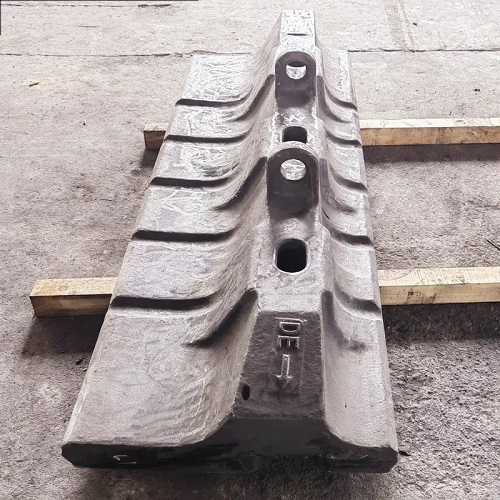
Practical Guide to Process Selection: Precisely Matching Based on Component Type
Selecting a casting process for specific crusher components fundamentally involves finding the optimal balance between “geometric complexity,” “mechanical properties,” “procurement budget,” and “delivery cycle.” We can establish a simple four-quadrant decision model:
For core components subjected to high impact and wear (e.g., jaw plates, grinding bowls, hammer heads), resin sand casting is the preferred choice. The additional cost is offset by extended service life and reduced downtime.
For structurally complex yet moderately stressed components (e.g., certain plate hammers or impact blocks), lost foam casting offers clear cost-effectiveness advantages. The key lies in identifying reliable suppliers capable of controlling porosity defects.
For simple, high-volume wear parts (e.g., guard plates, liners, screen plates), water glass sand casting remains the economical choice. Critical factors include defining clear acceptance standards and avoiding overly stringent dimensional tolerances.
Here’s a real-world decision case: An African mining client needed hammerheads for granite crushing. We ultimately recommended a “hybrid strategy”: resin sand casting for the most wear-prone first row of hammerheads, and lost foam casting for subsequent rows. This ensured overall crushing efficiency while keeping total procurement costs within budget, leaving the client highly satisfied.
Quality Inspection Essentials: Acceptance Criteria for Different Casting Processes
Regardless of the chosen process, mastering key acceptance techniques helps prevent procurement errors. For lost foam castings, focus on ultrasonic testing reports for “critical weight areas” (e.g., around thick mounting holes) to check for porosity defects. Simultaneously inspect surfaces for residual foam carbides.
When inspecting water glass sand castings, pay special attention to visible shrinkage cavities or cracks in “hot spot areas” (e.g., wall thickness transitions). During dimensional checks, prioritize measuring deviations near parting lines, where oversizes are most likely.
Resin sand casting acceptance is relatively straightforward: surfaces should be smooth and free of sand adhesion; tapping should produce a crisp sound without dullness; Most crucially, verify the material report to ensure alloy composition and heat treatment hardness meet technical specifications.
An experienced purchasing director once shared his secret: whenever a new supplier submits samples, he requests identical castings produced using three different processes. He then compares their weight, dimensions, and surface condition side-by-side. This visual comparison often reveals issues undetectable in technical documentation.
Among the three mainstream processes—lost foam casting, water glass sand casting, and resin sand casting—there is no absolute “best” option, only the most suitable match. Selecting the right casting process for your crusher is akin to choosing tires for an off-road journey across varied terrain: use economical tires for city roads, but muddy mountain trails demand all-terrain tires.
Next time you receive a casting component quote, ask yourself: What function does this part serve in the equipment? What are its primary failure modes? What is the downtime cost per replacement? Use these answers as your compass for process selection. You’ll not only acquire qualified components but also achieve optimal overall operational economics.
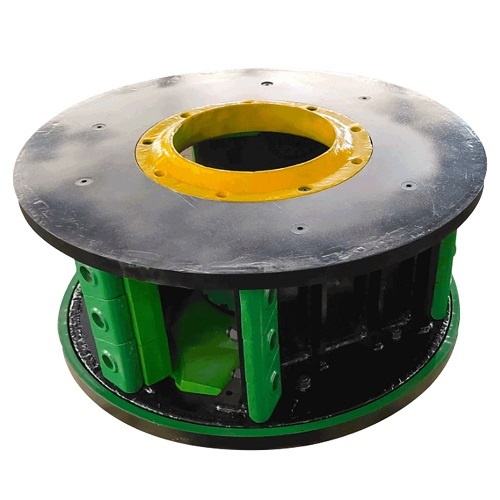
Frequently Asked Questions on Crusher Component Casting Processes
Q1: Why do high-manganese steel castings of identical material exhibit varying hardness across different casting processes?
This primarily relates to cooling rates. Resin sand exhibits poor thermal conductivity, causing slower casting cooling. This may lead to increased carbide precipitation and slightly lower matrix hardness. Water glass sand cools more rapidly, yielding finer grain structures and slightly higher initial hardness. However, final hardness is primarily determined by heat treatment processes, with casting techniques typically influencing hardness within a range of 1-3 HRC points.
Q2: How can one preliminarily identify the casting process used based on appearance?
Here’s a tip: Lost foam castings often exhibit slight wrinkling or orange peel-like textures on non-critical surfaces; Water glass sand castings exhibit relatively rough surfaces with common sand adhesion marks; Resin sand castings feature the smoothest surfaces with sharp edges, occasionally showing slight parting line flash. Of course, this is only a preliminary assessment; final determination requires comprehensive evaluation with other characteristics.
Q3: For small-batch, multi-variety component procurement, which process offers greater flexibility?
Lost foam casting offers clear flexibility advantages. Its foam patterns enable short production cycles and easy modifications, making it ideal for small-batch trials or replacement parts. Resin sand and water glass sand casting both require wooden or metal patterns, entailing higher initial investment and better suited for stable orders with consistent volume.
Meta Description:
A comprehensive comparison of the real-world strengths and weaknesses of lost foam, water glass sand, and resin sand casting processes in crusher component production. This article provides a comprehensive analysis covering cost, precision, and durability to help cross-border buyers precisely match processes with component requirements, optimize procurement decisions, and reduce overall equipment maintenance costs.
Core Keywords:
Crusher component casting process comparison
Advantages and disadvantages of lost foam casting vs. V-process
Differences between water glass sand and resin sand casting
Selection of production processes for wear-resistant castings
Mining machinery component procurement guide
Post time: Jan-30-2026