
High Manganese Steel vs High Chromium Iron vs Alloy Steel: Comparison of Mainstream Wear-Resistant Material Properties & Applicable Working Conditions
When purchasing crusher parts, the most troublesome thing for you is probably the choice of wear-resistant materials. Faced with familiar yet unfamiliar terms like “high manganese steel, high chromium iron, and alloy steel”, do you feel confused? With huge price differences and varying service lives, which one is most suitable for your working conditions? Choosing the wrong one not only means frequent equipment shutdowns and huge maintenance costs from replacing parts, but also directly affects your crushing efficiency and project profits.
From a frontline technical perspective, this article will in-depth analyze the “characteristics” of these three mainstream wear-resistant materials, helping you understand their respective advantages and disadvantages through real working condition comparisons and data. After reading this article, you will be able to accurately match the most economical wear-resistant material for different crushing conditions (such as crushing granite or concrete) like an expert, thus making the most sensible procurement decision. Next, we will disassemble the core secrets of these three materials one by one.
1. High Manganese Steel: Why Is It Still the Undisputed Choice for “High-Impact Working Conditions”?
When it comes to jaw plates of jaw crushers and concave liners, crushing walls of cone crushers, senior engineers often think of high manganese steel first. Its core advantage is not initial hardness, but its unique “work hardening” characteristic. Simply put, the hardness of this material is not prominent in the initial service stage, but it is precisely the huge impact and extrusion endured during work that cause the transformation of the surface layer structure. The hardness will quickly increase from about 200HB initially to more than 500HB, forming an extremely hard and wear-resistant surface, while the inner layer still maintains good toughness.
It is like putting an “ever-hardening armor” on the parts, which is very suitable for working conditions with severe impact and complex stress. A typical case is a jaw crusher used for primary crushing of hard iron ore in large mines. We once tracked a customer who used ZGMn13 high manganese steel jaw plates. When crushing iron ore with a compressive strength exceeding 250MPa, the service life of a single set of jaw plates was stably maintained at a processing capacity of 180,000 to 220,000 tons of ore.
If replaced with ordinary alloy steel with higher initial hardness, the wear may be slower in the early stage, but in the face of huge impact, the brittleness increases, and it is more likely to break or even chip, resulting in a shorter overall service life. Many buyers often ask: “Since it can become harder with use, should all crushers use high manganese steel?” This is a common misunderstanding. The work hardening of high manganese steel requires sufficient impact energy to “activate”.
In the secondary and tertiary crushing links with insufficient impact force, or when crushing materials with high abrasiveness but low hardness (such as some construction waste), its surface cannot be fully hardened, the wear rate will be very fast, and the cost performance will be low.
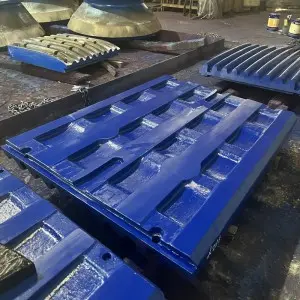
2. High Chromium Cast Iron: The Ultimate Answer for “High Wear, Low Impact” Working Conditions?
When the working condition changes from “heavy hammer impact” to “fine sand grinding”, the protagonist becomes high chromium cast iron. The characteristics of this material are almost the opposite of high manganese steel: it is famous for its extremely high initial hardness (usually up to HRC58-65) and excellent wear resistance, but its toughness is poor, brittleness is high, and it is very afraid of severe impact loads.
Its wear resistance mechanism relies on a large number of hard, dispersed chromium carbide (Cr7C3) hard phases, which are embedded in the matrix like countless tiny diamonds, directly resisting the cutting and chiseling wear of materials.
This characteristic makes it perform excellently in the impact heads and peripheral guards of tertiary crushing, sand making and vertical shaft impact crushers (sand making machines). For example, in an artificial sand production line with an annual output of 2 million tons, the impact head of the vertical shaft impact crusher used for tertiary crushing is one of the most vulnerable parts.
In a project we served, high manganese steel was initially tried, but the high abrasiveness of the material (river pebbles) caused it to exceed the wear limit within 300 hours. Later, it was replaced with KmTBCr26 high chromium cast iron impact heads. Under the same feed size and working conditions, the service life directly jumped to more than 850 hours, the wear resistance increased by nearly twice, and the comprehensive cost dropped significantly.
A key question often arises here: “Since high chromium cast iron is so hard, can it be used for all vulnerable parts?” The risk is extremely high. Using high chromium cast iron in parts that bear huge impact force, such as jaw crusher or impact crusher rotors, is very likely to crack or break entirely when hit by large materials for the first time, causing more serious equipment damage and production stagnation, which is not worth the loss.
3. Alloy Steel: A Universal Choice to Find the Best Balance Between “Toughness and Wear Resistance”?
Then, is there a material that not only has good toughness to resist a certain impact, but also has good initial hardness to cope with wear? This is the alloy steel family with multi-element alloying (such as adding chromium, molybdenum, nickel and other elements) and heat treatment process as the core. Their performance “adjustable range” is very wide. By changing the chemical composition and heat treatment process, they can find the best balance between toughness and wear resistance suitable for specific working conditions like a “custom-made suit”.
This makes the application scenario of alloy steel very flexible. For example, on the liners of secondary cone crushers or the hammers of impact crushers, the working conditions are usually between high-impact primary crushing and high-wear tertiary crushing. The low-alloy wear-resistant steel hammers we custom-developed for a limestone crushing production line in the southwest region have a hardness controlled at HRC45-50 and maintain sufficient impact toughness.
In practical application, it can not only bear the moderate impact brought by limestone blocks, but also its wear resistance is significantly better than ordinary high manganese steel (under working conditions without sufficient impact hardening), and the overall service life is increased by about 40% compared with the original scheme. Many equipment managers will be confused: “There are many types of alloy steel, how to avoid selection confusion?”
The trick is to clarify your core contradiction. If the material has extremely high abrasiveness but little impact, choose alloy steel with higher carbon and chromium content, focusing on hardness; if there is a certain block size and impact, appropriately increase the molybdenum and nickel content to ensure toughness. In-depth communication with reliable suppliers about the details of working conditions is the key to obtaining the correct “customized” scheme.
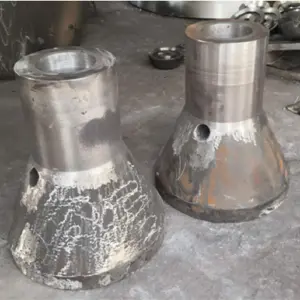
4. Practical Guide: How to Make the Optimal Material Choice According to Your Specific Working Conditions?
Understanding the characteristics of the three materials, the final step is to decide how to choose. This is by no means a simple question of “which is more wear-resistant”, but a comprehensive economic calculation involving material characteristics, equipment type, power consumption cost and even downtime. A simple decision logic is: first look at the impact, then look at the wear.
You can follow the following ideas: Step 1, evaluate the impact energy. If it is a primary jaw crusher or a large gyratory crusher with large material block size and high compressive strength, the first choice is high manganese steel that can “work harden”, using its toughness to “absorb” the impact. Step 2, if there is no strong impact, evaluate the material abrasiveness.
If crushing high-hardness, high-abrasiveness materials such as granite, basalt, and quartz sand, in tertiary crushers (such as vertical shaft crushers, tertiary cone crushers), high chromium cast iron is usually the king of service life and cost performance due to its ultra-high hardness. Step 3, if it is a “mixed” working condition with moderate impact and moderate wear, or you need a general choice with balanced performance and controllable risk, then cooperating with suppliers to custom-develop an alloy steel part is often a more economical and safer long-term strategy.
We once helped a mobile crushing station customer who processed both construction waste (containing steel bars, with impact risk) and concrete blocks (high abrasiveness). We recommended medium alloy steel with specific composition for the hammers of its impact crusher, and through optimizing the heat treatment process, it would not be brittle when encountering occasional “jamming and gnawing” of steel bars, while maintaining sufficient wear resistance, successfully solving the dilemma that high chromium cast iron was easy to break and high manganese steel was not wear-resistant before.
FAQ — Frequently Asked Questions
Q1: Can two materials be used in combination on one part, such as high chromium iron as the wear-resistant layer and alloy steel as the back plate? A1: Absolutely. This is a very advanced and efficient design, usually called “bimetal composite” or “insert casting” process. It uses the extremely high wear resistance of high chromium cast iron as the working surface, and uses alloy steel with good toughness as the supporting back plate, which not only ensures wear resistance, but also prevents overall brittle fracture. This process is often used for parts that require both high toughness and wear resistance, such as hammer heads and plate hammers, but the manufacturing cost is correspondingly higher.
Q2: It is said that high manganese steel is good, but why do the high manganese steel parts we use not feel wear-resistant? A2: This may involve several reasons. First, the working conditions may not match. If the impact energy of the crushed material is insufficient (such as small particles, low hardness materials), the surface of high manganese steel cannot be fully hardened, so it is naturally not wear-resistant. Second, it may be a problem with the material itself, such as improper manganese-carbon ratio or substandard heat treatment process (insufficient “solution treatment”), resulting in the insufficient exertion of its work hardening ability. Finally, improper installation and maintenance, such as loose fixing of parts, resulting in relative sliding wear, will also greatly reduce the service life.
Q3: When purchasing, how to initially judge the quality of wear-resistant materials? A3: In addition to relying on the supplier’s qualifications and reputation, you can pay attention to several points: first, ask for a material report to check whether the main chemical components meet the standards; second, if conditions permit, conduct a simple hardness spot check (such as using a Leeb hardness tester); most importantly, ask the supplier to provide actual application cases and wear data on similar materials and equipment. A responsible supplier should be able to give clear technical suggestions and expected service life evaluation based on your working conditions.
Meta Description (Google SEO Optimized)
Troubled by choosing wear-resistant materials for crusher parts? This article in-depth compares the core properties, applicable working conditions and cost benefits of three mainstream materials: high manganese steel, high chromium iron and alloy steel. Based on real cases, it teaches you step by step how to accurately select materials according to material hardness and impact force, avoiding frequent shutdowns and losses caused by wrong material selection. Read now to improve your procurement decision-making level!
Core Keywords (Google SEO Friendly)
crusher wear-resistant materials, high manganese steel vs high chromium iron, alloy steel wear-resistant parts, crusher parts selection, wear working condition analysis
Post time: Mar-05-2026