
High Manganese Steel vs. High Chromium Cast Iron: The Ultimate Guide to Selecting Crusher Wear Parts
High Manganese Steel vs. High Chromium Cast Iron: The Ultimate Guide to Selecting Crusher Wear Parts is a core issue that every cross-border buyer and wholesaler cannot avoid when stocking up. Many buyers report that even if they choose parts marked “wear-resistant”, either they crack or wear out within a month, or the cost remains high with constant complaints from end customers; many others cannot distinguish the applicable scenarios of the two, leading to inventory backlogs and increased losses due to blind purchasing. Combining my 15 years of experience in the crusher parts industry, this guide breaks down the core differences, applicable scenarios, and selection skills of the two, helping you avoid material selection mistakes, choose the right wear parts, reduce procurement costs, meet the actual usage needs of end customers, and improve repeat purchase rates. Next, we will clarify the material selection logic step by step starting from core characteristics.
I. High Manganese Steel Crusher Wear Parts: “Toughness King” Under Impact Load, Suitable for High-Impact Scenarios
The biggest advantage of high manganese steel (commonly known as Mn13) is its extremely strong toughness. It undergoes work hardening when impacted, with the surface hardness significantly improved, while the interior still maintains good toughness and is not easy to crack. This characteristic makes it the first choice for high-impact crushing scenarios and one of the types of wear parts with the largest stocking volume among cross-border buyers.
Let’s take a real case: Last year, a European mine buyer initially purchased ordinary wear parts for crushing basalt (high hardness and strong impact). The liners needed to be replaced every 15 days on average, which not only increased labor costs but also affected production efficiency. Later, they switched to our high manganese steel liners, and the service life was directly extended to 3 months. The maintenance cost of the end customer was reduced by 60%, and an annual procurement agreement was signed directly afterward.
Many buyers ask me: “Are high manganese steel wear parts suitable for all crushing scenarios?” The answer is no. The wear resistance of high manganese steel mainly relies on impact hardening. If the crushed material has low hardness and low impact (such as crushing limestone and gangue), its hardening effect will be very poor, and the wear rate will be much faster than that of high chromium cast iron, which is instead uneconomical.
II. High Chromium Cast Iron Crusher Wear Parts: “Wear-Resistant Expert” for Low-Impact Scenarios, Outstanding Cost-Effectiveness
The core advantage of high chromium cast iron is high hardness and strong wear resistance. It does not rely on impact hardening. In low-impact and high-wear scenarios, its wear resistance is far superior to high manganese steel, and the cost is 10%-15% lower than high manganese steel. It is a very suitable choice for buyers and wholesalers pursuing cost-effectiveness.
Let’s share another real case: A Southeast Asian wholesaler, mainly connecting with local small quarries, crushes mainly limestone and marble with small impact load but high requirements for the service life of wear parts. Previously, they purchased high manganese steel liners with an average service life of only 2 months. Later, they switched to high chromium cast iron liners, the service life was increased to 4 months, the procurement cost was reduced by 12%, the repurchase willingness of end quarries was significantly improved, and the wholesaler also became our core cooperative customer.
Here, we need to answer a high-frequency question from buyers: “High chromium cast iron has poor toughness, will it crack easily?” It is true that the toughness of high chromium cast iron is weaker than that of high manganese steel, but as long as the correct material grade is selected (such as Cr26, Cr28) and the thickness of the parts is adjusted according to the hardness of the crushed material, the cracking problem can be effectively avoided, which fully meets the usage needs of low-impact scenarios such as small quarries and construction waste treatment.
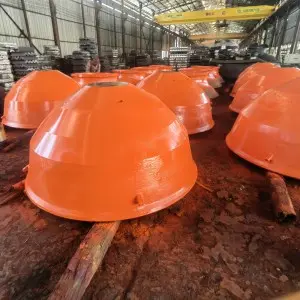
III. High Manganese Steel vs. High Chromium Cast Iron: Core Difference Comparison, Choose Correctly at a Glance Without Pitfalls
The core reason why many buyers choose the wrong wear parts is that they fail to clarify the core differences between the two and blindly pursue “wear resistance” or “low price”. Below, we make a clear comparison from four core dimensions: material characteristics, applicable scenarios, service life, and procurement cost, helping you quickly match your needs.
In terms of material characteristics, high manganese steel has strong toughness and requires impact hardening, suitable for crushing high-impact and high-hardness materials; high chromium cast iron has high hardness and does not require impact hardening, suitable for crushing low-impact and high-wear materials. In terms of applicable scenarios, high manganese steel is more suitable for mines and large quarries to crush hard materials such as basalt and granite; high chromium cast iron is suitable for small quarries and construction waste treatment plants to crush soft materials such as limestone and gangue.
Take a comparison case: The same customer uses high manganese steel liners when crushing basalt, with a service life of 3 months; when crushing limestone, they switch to high chromium cast iron liners, with a service life of 4 months and a 10% reduction in procurement cost. This is the importance of choosing the right material—it is not the more expensive the better, but the more suitable the better.
A common question from buyers: “If I crush both hard and soft materials, which one should I choose?” In this case, it is recommended to adopt “combined selection”: use high manganese steel for crusher liners (impact resistance) and high chromium cast iron for hammers (wear resistance). This can not only meet the crushing needs of different materials but also control procurement costs.
IV. Cross-Border Procurement of Wear Parts: 3 Selection Skills to Reduce Losses and Improve Competitiveness
As cross-border buyers and wholesalers, in addition to distinguishing the differences between high manganese steel and high chromium cast iron, you also need to master several practical selection skills to ensure quality, reduce inventory losses and procurement costs, and improve competitiveness in the local market.
The first skill is to clarify the crushing scenarios of end customers. When stocking up, many buyers only look at the general term “wear parts” and ignore the actual needs of end customers—for example, European customers mostly connect with large mines, focusing on high-impact scenarios, so it is suitable to stock high manganese steel; Southeast Asian customers mostly connect with small quarries, focusing on cost-effectiveness, so it is suitable to stock high chromium cast iron. Understanding end needs in advance can avoid inventory backlogs.
The second skill is to verify material grades and test reports. There are many low-quality wear parts on the market that pass ordinary steel off as high manganese steel or high chromium cast iron. When purchasing, you must ask the supplier to provide material test reports, confirm that the manganese content of high manganese steel is not less than 11%, and the chromium content of high chromium cast iron is not less than 26%, to avoid buying low-quality products that affect your reputation.
The third skill is to select materials in combination with logistics and inventory planning. High manganese steel has high density and weight, so cross-border sea freight costs are relatively high. It is recommended to purchase in bulk and plan inventory reasonably; high chromium cast iron is light in weight and low in cost, and can be stocked flexibly according to end needs to reduce inventory pressure. Many buyers have experienced backlogs and rust of wear parts due to poor inventory planning, increasing losses.

V. FAQ: Answers to High-Frequency Buyer Questions, Completely Clarify Material Selection Confusions
1. Which has a longer service life, high manganese steel or high chromium cast iron wear parts?
There is no absolute “longer” service life; the key lies in the applicable scenario. For high-impact and hard material crushing, high manganese steel has a longer service life; for low-impact and soft material crushing, high chromium cast iron has a longer service life and lower cost. For example, when crushing basalt, high manganese steel can be used for 3 months, while high chromium cast iron may only be used for 1 month; when crushing limestone, high chromium cast iron can be used for 4 months, while high manganese steel may only be used for 2 months.
2. How to control sea freight costs and transportation losses when purchasing wear parts cross-border?
In terms of sea freight costs, it is recommended to purchase high manganese steel in full containers to reduce unit transportation costs; high chromium cast iron can be purchased in consolidated containers to flexibly control inventory. In terms of transportation losses, ask the supplier to use moisture-proof and anti-collision packaging, mark “fragile, moisture-proof” on the packaging, and purchase cross-border logistics insurance to avoid damage to wear parts due to collision and moisture during transportation.
3. If end customers feedback that the wear parts are not durable, what may be the reason?
The core reason is improper material selection, followed by improper use. If the material selection is correct, it is likely that the end customer did not adjust the crusher speed and feed size according to the crushed material, leading to excessive wear of the wear parts. It is recommended that buyers ask the supplier for user manuals when stocking up and pass them on to end customers to guide correct use and reduce losses.
Conclusion
High Manganese Steel vs. High Chromium Cast Iron: The Ultimate Guide to Selecting Crusher Wear Parts, the core is “adaptation”—there is no best material, only the most suitable choice. High manganese steel is the “toughness king” for high-impact scenarios, suitable for large mines and hard material crushing; high chromium cast iron is the “wear-resistant expert” for low-impact scenarios, suitable for small quarries and customers pursuing cost-effectiveness. As cross-border buyers and wholesalers, as long as you understand end needs and master selection skills, you can choose the right wear parts, reduce procurement costs, improve repeat purchase rates, and gain a firm foothold in the fierce market competition. High Manganese Steel vs. High Chromium Cast Iron: The Ultimate Guide to Selecting Crusher Wear Parts hopes to help you avoid material selection mistakes, achieve efficient procurement and stable profits.
Meta Description
High Manganese Steel vs. High Chromium Cast Iron: The Ultimate Guide to Selecting Crusher Wear Parts, written by a 15-year industry technical expert, breaks down the core differences, applicable scenarios and selection skills of the two. Combined with real cross-border procurement cases, it helps cross-border buyers and wholesalers avoid material selection mistakes, choose the right wear parts, reduce procurement costs, improve end customer repeat purchase rates, adapt to B2B independent station procurement needs, and help efficient stocking and market expansion.
Keywords
crusher wear parts selection, high manganese steel vs high chromium cast iron, crusher liner procurement, cross-border crusher parts procurement, high chromium cast iron hammer selection
Post time: Mar-19-2026