
In the crushing workshop of a gold mine in South Africa, a technician noticed that the wear of the jaw plates presented abnormal serrated marks. This uneven loss is not merely material fatigue but a distress signal sent out by the entire crushing system. Learning to interpret the wear language of these metal surfaces often can plug the loss loophole of tens of thousands of euros before the equipment completely fails.
A micro-narrative of jaw plate wear
Normal wear of the jaw plate should be symmetrical and gradual, just like the uniform thinning of the sole of a shoe. However, when there is a local depression at the lower end of the fixed jaw plate, while the corresponding position of the movable jaw plate remains intact, the story becomes complicated. This usually indicates that a material accumulation has formed at the bottom of the crushing cavity, commonly known as “belly material”. The accumulated materials repeatedly buffer the newly fed materials, causing the actual working area of the discharge port to move upward, and the lower part of the jaw plate is instead subjected to idle friction. Measured data from a quarry in the United Arab Emirates shows that under such working conditions, the service life of the fixed jaw plate will be shortened by 40%, but the wear curve of the movable jaw plate is close to normal because the impact force is absorbed by the material cushion layer.
What is more concealed is the toothed fracture rather than wear. The maintenance records of a cement plant in the Ruhr industrial area of Germany show that the jaw plates cracked at the tooth tips after only 200 hours of use, while the material hardness test was completely up to standard. The problem lies in the particle size distribution of the feed – a small amount of super-large pieces of material exceeding the design value by 30% were mixed in. These “escaped fish” will get stuck at the upper part of the crushing cavity. When the movable jaw is forcibly closed, the tooth tips are subjected to instantaneous bending stress rather than compressive stress. This kind of fracture surface usually presents shell-like patterns, which are completely different from the smooth surface that fails due to normal wear.
The crime scene on the surface of the hammerhead
The wear pattern of the hammerhead is more like an impact log. Under normal working conditions, the working surface of the hammer head will form uniform impact pits, with the depth decreasing from the center to the edge. However, if a linear scratch with a depth of more than 15 millimeters is found on one side of the hammer head, while there is almost no wear on the other side, it can basically be determined that the rotor is unbalanced. An operator at a copper mine in Arizona once experienced a similar situation. After replacing the new hammer head, the vibration intensified. When disassembling, it was found that the back of an old hammer head was adhered to half a kilogram of debris from the crushing cavity liner, causing a weight deviation.
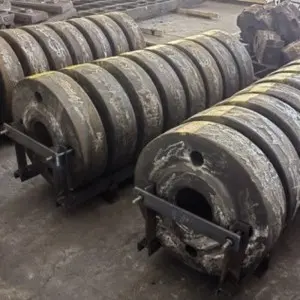
The debris from the lining plate of the crushing chamber adhered to the back of the hammer head, causing a weight deviation
The real danger lies in the “straight break” of the hammerhead – the fracture surface is flat and perpendicular to the hammer handle. This is not caused by impact but is the result of fatigue crack propagation. Interestingly, the source of fracture often occurs at the casting shrinkage cavities or inclusions inside the hammer head. A metal recycling processing plant in Mexico found through ultrasonic testing that 12% of the purchased hammer heads had internal defects. These hidden bombs would suddenly explode after working for 300 to 500 hours. There were no warning signs before the fracture, but the wear pattern would give clues: abnormally smooth bright bands appeared on the surface of the hammer head, which were the marks of repeated friction and polishing on both sides of the crack.
Neglected environmental witnesses
The analysis of wear patterns must be combined with environmental parameters. The wear rate of hammer heads at a certain iron mine in northern Canada in winter is 1.8 times that in summer. It is not the temperature that directly affects the performance of the steel, but the low temperature increases the brittleness of the material and raises the peak impact force by 20%. The seasonal morphological change of the worn surface from scratch marks in summer to spalling pits in winter is extremely likely to be misjudged as a material batch issue.
Humidity is another hidden killer. Unusual oxidation color and honeycomb-like corrosion pits have appeared on the surface of hammers at a nickel mine in Indonesia, and the wear rate has abnormally accelerated. On-site investigation revealed that during the local rainy season, the moisture content of the materials surged to 18%, and the surface temperature of the hammer head during operation could reach 200℃. Water vapor undergoes an oxidation reaction with iron at high temperatures, forming a loose oxide layer. These soft layers, after being washed away, expose fresh metal, creating an accelerated cycle of corrosion and wear. This type of wear pattern hardly occurs in dry areas.
The mismatch code between materials and working conditions
The surface of the high manganese steel hammer head should form a work-hardened layer, with the hardness increasing from HB200 to above HB500. However, if the hardened layer never forms, the wear pattern will show rapid smoothness – the tooth Angle will be worn flat within 50 hours. This often means that the impact energy is insufficient to trigger the martensitic transformation. After a certain construction waste recycling station in Australia reduced the rotor speed of the hammer crusher from 35 meters per second to 28 meters per second, the service life of the hammer heads plummeted from 80 hours to 40 hours, and the wear pattern changed from normal impact pits to sliding scratches. The reason was that the impact energy was lower than the critical hardening threshold.
On the contrary, the brittle fracture of high-chromium cast iron hammer heads presents a different wear narrative. This material is extremely hard but lacks toughness. When crushing water-containing materials, a network of cracks will appear on the surface of the hammer head. A limestone quarry in Spain was puzzled by this issue for a long time. It was not until failure analysis revealed that the clay components in the material formed slurry during crushing, blocking the gap between the hammer head and the material. As a result, the impact force could not be effectively transmitted, and the hammer head struck the elastic cushion layer like hitting a stone. The repeated internal tensile stress eventually led to brittle fracture. The crack morphology is radial, and the center point is the stress source.
The transformation path from form to decision
Interpreting the wear pattern is not for writing a report, but for adjusting the operation parameters. Seeing that the lower part of the jaw plate wears out three times faster than the upper part, the most direct reaction is not to change to a more wear-resistant material, but to check whether the discharge opening is too small, causing repeated breakage. After adjusting the discharge gap from 80 millimeters to 100 millimeters, the service life of the jaw plates in a certain Argentine mine was directly extended by 60%, and the wear pattern returned to uniformity.
When the hammer head shows uneven wear, don’t rush to replace it as a whole. The practice of a certain mine in South Africa is to stop the machine and rotate the hammer head direction once every 8 hours to evenly distribute the wear across the four working faces. In conjunction with this operation, they recorded the wear rates at different angles, established a hammerhead life prediction model, and reduced the spare parts inventory from three months of usage to one month.
The most practical experience is to establish a wear pattern map. Take weekly wear photos with your mobile phone, and after three months, you can directly observe the slope changes of the wear curve. A German engineering company has developed a free APP that allows operators to upload photos of wear and tear, and the AI will automatically mark the abnormal areas. Although the algorithm is simple, it enables non-professionals to participate in failure analysis, reducing the sudden failure rate of equipment by 35%.
The wear pattern of crusher parts is never random scars, but rather a geological layer of interaction among equipment, materials and operation. Understanding the annual rings on these metal surfaces can rewrite the outcome before faults occur. The next time you replace the jaw plate or hammer head, it might be a good idea to spend an extra ten minutes observing the worn face of the old part. The story it tells is worth far more than the price of that new piece of metal.
Post time: Dec-04-2025