
Coarse corrugations vs. Fine corrugations: How to Select the Correct Jaw Plate Tooth Profile Based on Material Characteristics?
In the crushing operation scenario, the jaw plate is a core vulnerable part that determines the equipment’s production capacity, material particle size and operation and maintenance costs. Many operators and purchasing teams often get stuck on the choice between coarse corrugations and fine corrugations when replacing jaw plates. In fact, there’s no need to be overly concerned. The key lies in accurately grasping the core characteristics of the material – choosing the right tooth profile can not only significantly enhance the crushing efficiency but also greatly extend the service life of the jaw plate and reduce the trouble of frequent replacement.
Coarse corrugated jaw plate: A “crushing powerhouse” for hard and large pieces of material
The most distinctive feature of the coarse corrugated jaw plate is its wide tooth pitch and deep tooth root. This design is inherently suitable for handling materials with high hardness and large size. In scenarios such as mining and basalt crushing, the materials are hard and large in size, which requires the jaw plates to have stronger grasping capacity and impact force. The deep-toothed structure with coarse corrugations can firmly “bite” large pieces of material, preventing slippage and idling during the crushing process, and ensuring that the crushing force can be effectively transmitted to the interior of the material.
In addition, the discharge space of the coarse corrugated tooth shape is relatively larger. For hard materials with low moisture content and less prone to adhesion, it can reduce the risk of blockage and ensure the continuity of the operation. However, it should be noted that if coarse corrugated jaw plates are used to process fine or soft materials, it is very likely that the problem of uneven crushing particle size will occur, and it may also accelerate the wear of the teeth, which would be counterproductive.
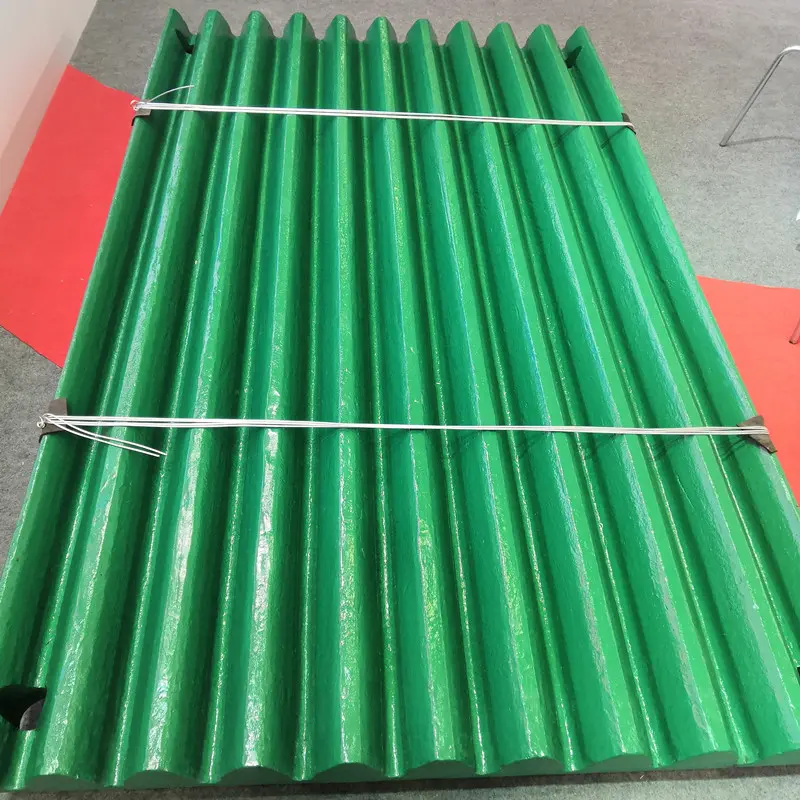
Fine corrugated jaw plate: The “precise partner” for fine and soft materials
Compared with coarse corrugated plates, fine corrugated plates have smaller tooth pitch and shallower tooth depth, making them more suitable for processing materials with lower hardness and smaller block size, such as limestone, shale, and coal. This type of material does not require extremely strong impact force. Instead, it has a higher requirement for the uniformity of the crushed particle size. The fine corrugated tooth shape can “grind” the material into a more regular particle size through the dense tooth surface contact, meeting the processing needs of the building materials, chemical and other industries.
When dealing with materials with slightly higher moisture content, fine corrugated jaw plates also have advantages. Dense fine teeth can reduce the adhesion of materials on the tooth surface and prevent the formation of a material layer that affects the crushing efficiency. Moreover, the wear of the fine corrugated tooth surface is more uniform. For production lines that need to operate continuously for a long time, it can effectively reduce the replacement frequency of vulnerable parts and control operation and maintenance costs.
The core of selection: Comprehensive consideration from material characteristics to production requirements
In addition to the hardness and size of the material, when selecting the model, the production goals and equipment conditions should also be taken into consideration. For instance, if the production line requires a finer final crushing particle size, fine corrugated jaw plates should be given priority. If high production capacity is pursued and large hard materials are processed, the coarse corrugated jaw plate is undoubtedly a better choice.
The abrasiveness of the materials should not be ignored either. For abrasive materials (such as quartz sand), regardless of which tooth profile is chosen, the material of the jaw plate should be taken into consideration. However, in terms of tooth profile selection, the tooth root of the coarse corrugations is thicker and has relatively stronger wear resistance. Materials with weak abrasiveness can be flexibly selected according to the required particle size. In addition, the adaptability of different models of crushers to the tooth profile of the jaw plate also varies. When selecting a model, it is best to determine it in combination with the equipment parameters.
In fact, there is no absolute superiority or inferiority in choosing the tooth shape of the jaw plate. The key is to “treat the symptoms and the root cause”. Many front-line teams often encounter problems of low efficiency and rapid wear and tear because they neglect the matching degree between material properties and tooth shapes. It is recommended that before replacing the jaw plate, samples of the material be taken for analysis to determine its hardness, size, moisture content and abrasiveness. Then, the tooth profile should be determined in combination with production requirements. Only in this way can the crusher perform at its best.
Post time: Dec-12-2025